


Easy pad thai
Easy pad thai is a delicious, healthy dish that can be whipped up very quickly. If "easy" makes you think this isn't an authentic pad thai, think again. Thailand's national dish is easy and quick to cook. This is an ever popular version with chicken, prawns and tofu, but it can easily be turned vegan or pescatarian. With rice noodles, garlic, tamarind, lime and peanuts, among other flavours, what's not to like?
Officially Thai
Pad Thai is one of those iconic Thai dishes known all around the world and, indeed, it was one of the dishes included on the approved menus of the Thai Government’s Global Thai programme in the early noughties that helped establish new Thai restaurants abroad, now considered one of the earliest and most innovative examples of Culinary Diplomacy. If you are interested, you can learn more about that here.
Regardless of which particular origin theory you believe, the one thing on which they all agree is that this was a dish invented during the 20th century and is not some ancient Thai culinary tradition. Even its nationalistic name indicates this. As with much of what is now considered “traditional” Japanese food, there are various theories about how pad thai came into being, but most of them are located in the geopolitical shifts in Asia during the 20th century.
One theory is that it was invented as a street food by Chinese vendors in the 1930s—mirroring their influence on Japanese food in the 20th century. Another is that it was as a result of the Thai government's wartime encouragement of the Thai people to eat more noodles in light of the rice shortages during WWII with a contemporaneous series of devastating floods.
But, regardless of exactly how it came to be invented, it was certainly instrumentalised in Thailand’s forging of a national modern identity under the leadership of Prime Minister Plaek Phibunsongkhram during the mid-20th century. This nationalism is at the heart of pad thai’s name and even today, it is officially the national dish of Thailand as defined by official agencies. It was originally called sen chan pad thai, named after Thailand’s Chanthaburi Province, but its name was later shortened to simply pad thai. This in itself is indicative of how it became a signifier of a modern nation state rather than remaining a regional dish.
It also raises questions about why it would have been originally named after this southern coastal province on the Gulf of Thailand. One explanation is that it was because this area had a large population of ethnic Chinese immigrants who influenced cooking in the region with their own noodle-based cooking and is, therefore, very likely to have originated there. Even today Chanthaburi remains on of Thailand’s centres of production for the rice noodles used in this and numerous other dishes.
Interestingly, various polls and surveys show that most Thai people consider pad kra pao—spicy stir-fried minced meat, holy basil, and chilies served over rice, often topped with a fried egg—or tom yum goong—a fiery and sour prawn and shrimp soup—as being more definitive of everyday Thai cuisine than pad thai. Yet, it remains the official national dish, probably because it is one to which tourists, major economic contributors to the Thai economy since the late 1970s, had been exposed and decided to like. After all, part of the success of the Global Thai programme of the early noughties was to take a rinse-and-repeat approach, cannily focussing on pushing Thai dishes in the international market that already had some proven success among foreigners, both as tourists or in immigrant Thai restaurants abroad.
This is another recipe taught to me by my friend Winnie, my mentor in most of the Thai cooking I have learned. One of the things I quickly started to understand is that pad thai is a dish more defined by its core key ingredients than the cooking process itself. Like spaghetti bolognese or Irish stew elsewhere, while the core ingredients are usually the same, the methods for cooking pad thai vary from person to person in Thailand. Some create the sauce first before adding to the wok, others add the constituent ingredients directly into the wok; some cook the prawns and chicken first, adding them back into the wok later, others add them first and leave them in for the duration of the cooking; and some whisk the eggs before putting in the wok, and others don’t; and so on.
I’m using the method Winnie taught me, one that he thought produced the best results with the least effort, but there is nothing wrong if you use a slightly different process, nothing more or less “authentic” between these different cooking methods, since the methods used to cook it in Thailand are a pluralism and not monolithic.
Swings and roundabouts
I have seen pad thai cooked using a number of different processes and each have their advantages and disadvantages. It also comes down to the forms in which you can access the ingredients where you are. For example in Thailand I observed many vendors in markets not making a sauce in advance, but simply adding the tamarind, sugar and oyster sauce, unmixed, into the pan. However, the tamarind used in Thailand was often more like a "juice", blocks of tamarind ground down with a pestle and mortar, strained and diluted with water. But, in the UK and various other parts of the world, tamarind is more likely available as a concentrate or a paste available from specialist outlets and is not that easily absorbed. Of course, you may be able to buy blocks of tamarind where you are and make your own. But, after years of doing this, I moved to using readymade tamarind pastes. I really cannot taste the difference in the final dish and it’s certainly less of a hassle. Also, it’s less wasteful: I cook a lot of Thai food, but not enough to get through the large blocks in which tamarind is sold and lots of it ended up in the composter.
Similarly, palm sugar dissolves more easily than other sugars, even more so given pad thai is not cooked at a very high temperature. So, if you only have access to other e.g. brown or muscovado sugar, I find it better to mix this together with the tamarind paste, adding a little boiling water if your paste is overly thick, before putting it into the wok.
The chives are also a matter of availability. In Thailand—and China and Southern Hemisphere places that have taken to them—pad thai uses garlic chives. However, in the UK and much of Europe, garlic chives can be hard to find, even at specialist grocers. So, unless you grow them yourself, my solution is to use more conventional fresh chives and slightly increase the garlic content in the dish. Alternatively, if you live somewhere where wild garlic grows, you can use the stems of these instead. But I wouldn't stress about it. More common chives work just as well and this, after all, is supposed to be "easy pad thai". But, in terms of the final garnish, I came across quite a lot of street food stalls that used shredded spring onions instead of garlic chives, so that's also an option.
With the raw king prawns, in Thailand the tails will be left on and you can readily do that if when shelling and cleaning them is you are buying them in their shells But I call this "easy pad thai" and in the UK king prawns that have already been shelled and cleaned come without their tails, so I am using those.
I've seen quite a few recipes from outside of Thailand—USA, Australia, UK, etc.—that add sliced onions to the early stages of the dish. I never once saw this in Thailand and nor is it part of the recipe Winnie taught me. So, I'm not adding them. But, no reason you can't.
Take note:
This version is for 2 diners as a main course. You can easily scale it up or down, proportionally increasing the quantity of noodles, eggs and other proteins. But, only increase the tamarind paste, sugar, oyster sauce and fish sauce by 25% for each additional two diners. You can always add more as you cook, but you can't repair "overdosing" on these strong flavours once they go into the wok.
While easy, what doesn't make this dish "quick"—without a little pre-planning—is soaking the noodles overnight, the method I was taught and my preferred method. I'm usually pretty good at remembering to soak them in water from the night before I want to cook the dish. But, if you're taken on a whim and haven't had time to do so, the quick hack is to place the noodles in a bowl and pour in enough boiling water to fully submerge them. Leave for no longer than 5 to 8 mins, then drain, immediately thoroughly rinsing in cold running water and jostling about to prevent them from sticking to each other.
This dish stores well in covered the fridge for a couple of days but, because of the ingredients, I never keep it for more than two days. It does not freeze well. In Thailand, leftovers will often be eaten cold as a salad the next day with additional peanuts, (garlic)chives, and a dressing made from.sweet chilli sauce mixed with roughly equal parts of lime juice. I find this delicious salad the best choice since it doesn't really re-heat that well either in a wok or microwave. The bean shoots go soggy, the egg becomes hard and the prawns came become rubbery, etc.
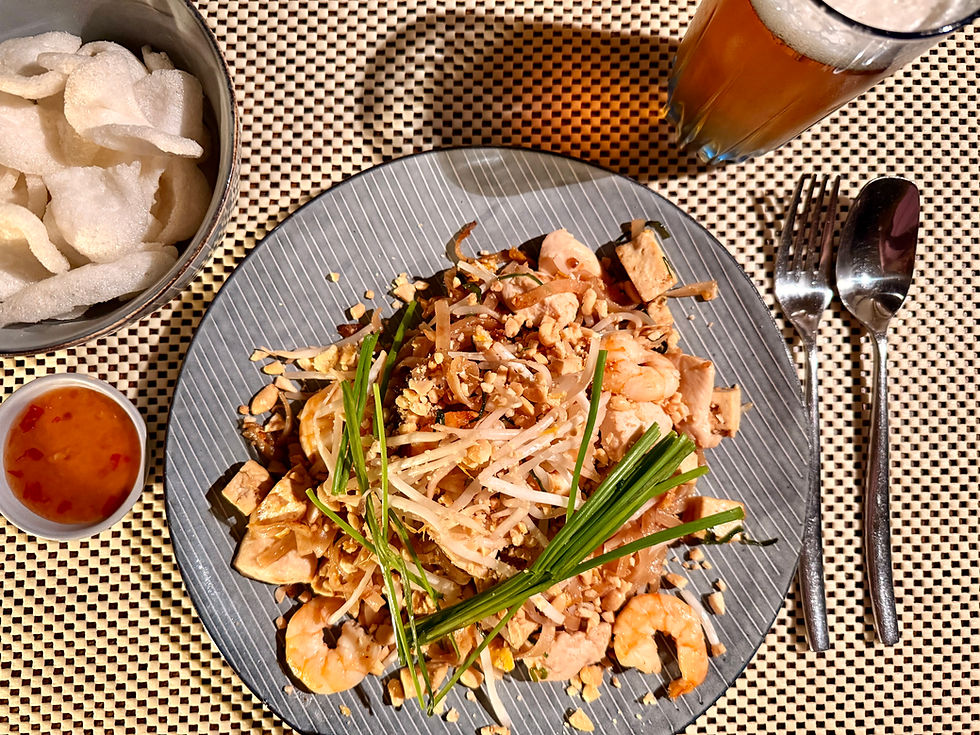
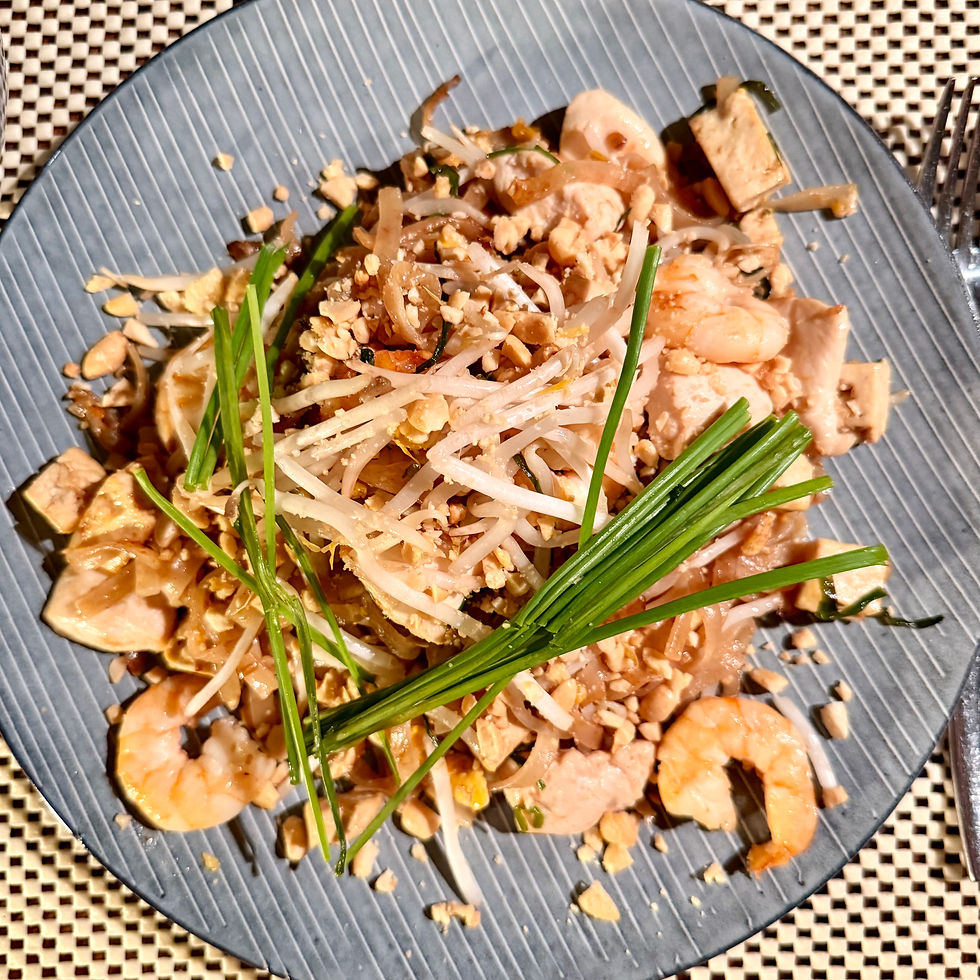
Please note that in the images I am cooking it in half the quantities of the recipe below; pad thai for one. Well, technically that for one time two: I get a very good lunch salad out of it.

3 top tips to get this recipe right: |
|
|
|
Shopping list
for the easy pad thai
200g Thai rice noodles (look for they type called pad thai noodles or sticks)
1 large skinless chicken breast, cut into bite-sized pieces
14 to 16 raw king prawns; shelled; fresh or frozen and fully defrosted
Approx. 200g tofu, cut into large cubes
2 eggs
5 handfuls of fresh bean sprouts
2 to 3 tbspn rice bran oil (or vegetable oil)
3 cloves garlic , finely chopped
A generous clutch of fresh chives (or garlic chives)
2 tbspn tamarind paste; see above
2 tspn brown sugar (or equivalent in palm sugar)
2 tbspn Thai fish sauce (or the vegan version)
1 tbspn oyster sauce
2 handfuls of roasted peanuts; roughly crushed
1 tspnThai sweet soy (optional)
Prawn crackers and dipping sauce Lime wedges
Side dishes
As a street food, pad thai is seldom served with any side dishes though I can never resist having some Thai crackers (khao kriap), whether of the prawn cracker type or the spicy variety with chilli flakes. And, of course, a little sweet chilli dipping sauce.
Pad thai is served with a number of garnishes. The peanuts and raw bean shoots, both added at the end, are an intrinsic part of the dish and added everywhere I have encountered it.
I prefer to crush the peanuts with a pestle and mortar and not a mini chopper because it gives easier control over the peanuts, which should be broken or roughly crushed rather than finely chopped or ground.
The lime wedges, while ubiquitous where the dish is served outside of Thailand, are not as much of a prerequisite as one might think in Thailand itself. Quite a few street food stalls in Bangkok sold it without lime. And, particularly in Chanthaburi, where this dish is everywhere and some claim where it originated, I encountered a lot of street vendors who had jars of pineapple pulp on their stalls, offered as an alternative to squeezing lime juice over the dish. But, I love it with lime, so almost always serve it with lime wedges.
Other condiments served on the side of the dish include dried hot chilli flakes, banana flowers or Thai pickled daikon (sometimes labelled as pickled turnip and not the same as Japanese or Chinese pickled daikon), which often comes in the form of dried flakes. Sometimes these pickled daikon flakes are used as a cooking ingredient, added into the wok towards the end of the cooking.
Cooking Method
the easy pad thai
Soak your noodles in cold water overnight in the fridge then drain just before cooking. If you do not have time to do this, see the 'Take Note' section above for the quick hack
Before you start cooking, mix the tamarind paste and sugar together in a cup or small bowl. If the paste is very thick, add a little boiling water e.g. about 20ml to help mix in the sugar
Heat approx. 2tbspn of the oil in a wok on a medium heat. Add the chicken pieces, followed a minute later by the prawns and cook without any seasoning until almost cooked. Remove using a sieve spoon and place to one side
Add a little additional oil to the wok. When hot, add the garlic and sizzle, stirring frequently, turning the heat down if necessary to prevent burning
When the garlic begins to turn golden, add the noodles and the tofu to the wok, adding an additional dab of oil. Stir thoroughly and mix with the garlic. Cook for a few minutes until the noodles show initial signs of softening
Push the noodles and tofu to one side of the wok. Break the eggs into the wok, ensuring you break the yolks. Allow to cook for about 30sec, then fold into the noodles, ensuring the egg is spread throughout as it cooks
After barely a minute, add the tamarind paste and sugar mixture into the wok and fold into the other ingredients. Almost immediately add the oyster sauce and mix in, followed by the fish sauce. Cook for approx. 4mins, stirring constantly
When the noodles have somewhat softened and absorbed the sauces, add the chicken and prawns back into the wok. Cook for another 4 to 5min, stirring constantly
When the chicken and prawns are optimally cooked, taste a piece of one of the noodles, checking to see that it is is fully cooked—it should be slightly al dente but fully cooked—and for the taste of the sauce. Add additional fish sauce if needed and cook for a minute or slightly longer, depending on whether your noodles are ready. If using, also add the Thai sweet soy at this point
When the noodles are done, roughly break half of the chives into the dish and fold in, allowing them to cook for a minute or so
Remove from the heat and add half of the bean sprouts and fold them in. You don't want them to cook, but rather to wilt within the heat of the dish itself. Cover and rest for barely a minute
Plate, garnish with the remaining bean sprouts and crushed peanuts and immediately take to table with lime wedges and any other condiments or side dishes
Alternatives
I am serving the popular version here that uses chicken, prawns and tofu. Other combinations are commonplace, but the tofu is the red thread that runs through most.
To make a lactovegetarian version, simply omit the chicken and prawns and increase the quantity of tofu— adding plant-based (e.g. Quorn) "chicken" pieces if you like—and use one of the many vegan "fish" sauces now available. You do pretty much the same for the vegan version, the main challenge being that, without eggs, the noodles lack a certain "silkiness". The traditional Thai solution is to use a tablespoon of Thai sweet soy sauce. It will give the dish a darker appearance, but it's still delicious. Incidentally, Thai sweet soy was used as the traditional ingredient for vegans before the invention of vegan "fish" sauce, so you can bypass "fish" sauce completely, using a little more Thai sweet soy earlier on.
Pescatarian versions, with or without the tofu, abound. You can either simply increase the quantity of king prawns or you can add squid or crab, both common in Thai versions.
Chicken or duck are the only versions I have ever come across in carnivore iterations in Thailand and I have never been tempted to try other types of meat,
Pairings
I almost always pair this dish with beer or white wine. Whether Thai beers such as Singha or Leo, or other pale ales, a chilled beer is great with this dish.
Given that this is an "easy" dish that I will often cook midweek and seldom on special occasions, most of the white wines with which I have paired it have been modest affairs and I can't remember most of them specifically. Overall, I think the sauvignon blancs work well and do remember liking it with a Kiwi white, Mt. Richmond Sauvignon Blanc. But I also loved it with an Argillae Panata Orvieto Classico Superiore, a blend of three grapes, two of them lesser known heritage varietals. With a definite note of marzipan—or is it cyanide?—this pairs wonderfully with that vaguely rancid delight in Thai fish sauce.
One the teetotal front, this dish pairs wonderfully with mineral water infused with lime.


Comments