


Thai red curry
Thai red curry is one of the best-known Thai dishes around the world. One of the four in the quartet of Thailand's most successful culinary exports, it can be vegan, pescatarian or carnivore. More importantly, if you use this recipe based on how street vendors produce it, it's easily adaptable to the needs of dining parties with different requirements.

Red notice
This is another of the recipes taught to me by my friend Winnie, my unlikely drag guru in all things relating to Thai food. But, Winnie's guidance when teaching me his recipe for Thai red curry was not the patrician view he took towards the other three curries in the Thai "big four" but rather to look at the approach taken by street vendors, looking to always build the base curry first, even if you know that you're making a chicken or beef version i.e. never browning any meat into the curry in the early stages—as is the received wisdom in many Western recipes typically detailed on supermarket pre-made sauce bottles—but always to get the base right first and only then to add the desired protein into the mix.
His belief is that this particular curry, though well-known around the world, is the least understood. He gave me examples, talking about how Western writers often talk about red curry being milder than both yellow or green Thai curries as if it were standard. But, in his opinion this is (forgive the pun) a red herring. According to Winnie, the level of heat in a red curry varies wildly from region to region and is as much a matter or personal taste as tradition. Similarly, while the rest of the world refers to "Thai red curry", apparently in Thailand, the two red curry pastes—one with the toasted coriander and cumin seeds, the other without—are seen as different things and have different names. While both can be found all over Thailand, the former, clearly has a stronger Indian influence than the latter.
Like the other classic Thai curries originating in central Thailand with their origins over a thousand years ago with influences from all over Asia, the versions we know today are largely the result of what followed the Portuguese introducing chillies to the Indian subcontinent, and recipes that arose in the 16th-century as the use of chillies spread around Asia. As Winnie was at pains to point out, the important thing is to first understand how spicy your baseline red curry paste is. After that, you can work out how many—if any—additional fresh chillies you want to add to a particular curry.
I am including the Thai red curry paste recipe that Winnie passed on to me. And, I would say that is has more heat than the average bottled Thai red curry pastes produced in the West and sold in supermarkets.
But, I must stress that it is very rare that I make it from scratch these days. Part of it is convenience, and that's not only me. One of the things I learned in Thailand is that many Thai people with busy lives do not make their own curry pastes as home. Many buy large-scale brands that are respected in Thailand or buy them fresh at "wet markets". Just as canny Italians will buy fresh ravioli from quality local producers and most Belgians prefer to buy their good-to-go fresh brown shrimp croquettes from esteemed local artisans rather than toil at home, you come across specialist curry paste vendors in the vibrant markets all over Thailand that offer top quality plug-'n-play fresh curry pastes. And, they can be quite specialised. For example, I remember Winnie showing me vaunted producers in Bangkok's famous Pak Khlong Market not selling curry pastes, plural, but only selling the red or green curry pastes for which they were renowned.
The other aspect is that dried (supposedly) Thai red spur chillies vary incredibly in their heat level depending on where in the world you're buying them. I have found it much more "predictable" to buy pre-made Thai red curry pastes produced by three leading brands produced in Thailand—each with a different level of spiciness—for the results to be replicable. Thus, here I am using Mae Ploy Red Curry Paste that is available in many locations around the world. The reason I prefer this one is because both its ingredients and their proportions seem most similar to the one that Winnie taught me to make; a rather painstaking process.
Colour coded culinary diplomacy
Thai red curry is undoubtedly one of the "Big Four" of the world's best known Thai curries—red, yellow, green and massaman. But how and why this happened is an intriguing story. While Thailand really broke through as a tourist destination in the 1960s, back then it remained a fairly "exotic" destination to which only the well-heeled and adventurous travelled and, even though these travellers brought back tales of exquisite, unique cuisine, the handful of Thai—or Siamese as they were styled back then—restaurants in Paris, London or NYC remained rather upmarket and exclusive.
Ironically, the watershed for exported Thai cuisine was the Vietnam War. American and Australian service personnel heading to or from Vietnam would often spend time in transit bases in Thailand. They shared their love of the food and the country with those back home. The era also saw a growth in Thai emigration, Thai people seeking new opportunities elsewhere in the world. As with many diasporas, the food service industry was somewhere where immigrants could traditionally succeed, setting up restaurants. Naturally, the word-of-mouth enthusiasm for the food by those who had served or worked in Thailand was helpful, mirroring the much earlier examples of Britain embracing Indian food or the French appetite for North African cuisine. This, together with the increasing numbers of tourists returning from Thailand saw a steady growth of awareness—and liking for—Thai food across the Americas, Europe and Australasia.
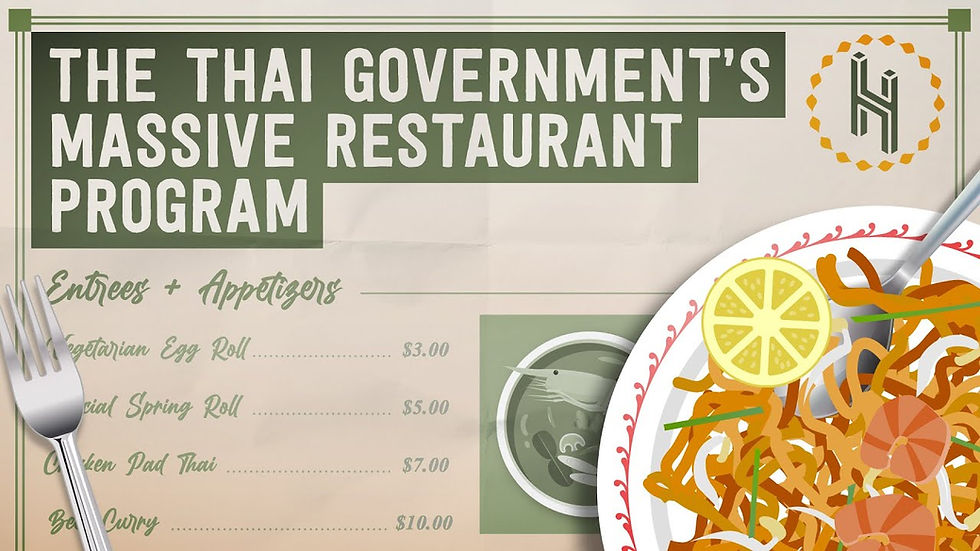
In 2002, building on its exponentially expanded tourism sector, the Thai government launched its Global Thai programme, now considered one of the earliest and most innovative examples of Culinary Diplomacy. It was also one of the most prescriptive. It offered a readymade approach to opening a Thai restaurant abroad, right down to prefabricated menu plans focussing on three market segments from high-end to fast food. It also came with financial incentives for those who planned their restaurants according to the template business plans the programme disseminated, along with the PR incentive that those participating would benefit by going on the "official" list of "quality" Thai restaurants abroad published by the Thai government.
While no one questions its economic impact—it has since spawned many copycat exercises in Culinary Diplomacy by other nations—some, including award-winning chefs with restaurants outside of Thailand, have questioned its impact on the perception of Thai food abroad. They rightfully question whether it hasn't led to a narrowing of the perception of Thai food; an awareness of only the Thai "greatest hits"—including Thai red curry—at the expense of the visibility of other regional cuisines. .
A good example might be a small Thai restaurant in London that built up a following in the mid-90s for its Northern Thai cuisine. It was a pleasant affordable place in North London to which those with fond memories of visiting Chiang Mai and the surrounding regions would flock for its delicious grilled Thai sausage. I'm sure business was tough. Apart from surprised walk-ins expecting the usual curries, it's clientele were mostly those who had backpacked around Thailand and were not known as big spenders.
I loved the place and had got chatty with the chef/owner over the years. In the mid-Noughties, I was utterly stunned to learn that they were closing down. I told him that I was shocked: they were always full. He told me it wasn't about business. Or rather it was. He told me that as the owner of an existing restaurant, he wasn't eligible for the enticing incentives of the Global Thai programme. So, he was closing it down to open a new business entity within the parameters of the programme. Given the success of his restaurant, he already had investors lined up.
About a year later, I went to his new venture in West London, a vastly bigger, much more chichi and more expensive affair. The food, as always, was excellent. And, of course, the "Big Four"—including the inevitable Thai Red curry—were large-writ on a menu from which most of the less common Northern Thai dishes had disappeared. I do get it: he had decided to make his hard work (he still oversaw the kitchen) reward him better.
This all probably seems bizarre, perhaps even critical of the dish I'm publishing here. It's not. It's just a cautionary tale to remember, that Thai food is a lot more than "the familiar"and, in the West, something that is always influenced by the cuisines of the culture into which it is transplanted. For example, I have never seen frog legs on a Thai menu in London—something one finds at roadside stalls in Bangkok—and certainly in Thai restaurants in Belgium and France, for pretty obvious cultural reasons.
My nod to this story is the inclusion of pea aubergines in this recipe, something that one seldom finds in a red curry in a London Thai restaurant. But, I did in that new restaurant in Notting Hill created by a man who would occasionally colour outside of the lines while toeing the line to create new opportunities for himself, his investors and employees. For years, I couldn't find these tiny aubergines in London but now they can be found in a new generation of South East Asian supermarkets. Things change.
Vegetable savvy
As with other Asian cuisines, Western recipes, especially "serving suggestions" on the sides of pre-made sauce jars in supermarkets oversimplify the vegetables—"add the vegetables"—as if they were all the same. This has fed another fallacy: that all the vegetables should be "crunchy". As anyone who has eaten red curry at a roadside stall or in a family home in Thailand, or been to a good Thai restaurant elsewhere, will know, this is not the case. Carrots are not crunchy and the mangetout are cooked. It's is not a salad over which you have poured some spicy soup. Thai cooks think carefully about which vegetables should be crunchy—for example, whole or large pieces of baby corn will have an element of crunch, even when properly cooked—while others, like slices of carrot, should be tender without being mushy... unless in a side salad, pickle or condiment.
As in the recipe below, they add the vegetables in batches, first the ones that need to cook longest—carrots, celery, baby corn, etc.—and later the ones that do not—mangetout, sugar snap peas, pea aubergines etc. These curries will often be kept warm for hours in stalls or restaurants, portions being removed, the protein of choice added, and then cooked in before serving. Or, in private households, red curry is often cooked up in a large batch with portions put aside before adding the protein for a second meal. This makes complete sense. In Thailand's warm climate—pre-refrigeration—this primarily vegetable curry, save for a small portion of fish and seafood (in the fish sauce and shrimp paste in the curry paste, both of which are fermented i.e. do not require refrigeration) could be safely stored for longer. Adding meat or seafood to curry that would not be sold or eaten within hours posed a higher risk of food poisoning or waste of resources.
Though perfectly safe to store batches with the protein already added in sealed containers in a fridge for a couple of days and up to a month in a freezer, I always take the Thai approach, saving any additional curry from a batch before adding any proteins. There are two main reasons for this. One is a question of flavour. Thins strips of beef, chicken pieces, seafood and tofu all taste better when they are cooked for barely a few minutes in the hot curry immediately before serving.
The second is choice. Yes, we all know some people are creatures of habit and will only ever want to eat chicken Thai red curry, for example. But, if I am going to eat red curry twice within a few days, I like mixing it up, for example, a tofu version one day and a prawn version another. I also usually extend that notion of variety to the side dishes. Jasmine rice on one occasion, sticky rice on the other; simple prawn crackers on one day, and fish or sweetcorn fritters on the day when I have more time and energy.
Actually, that last example was probably misleading: I love Thai sweetcorn fritters (tod mun khao pod) and one of the benefits of making a batch is that there will be enough left over for another Thai supper—or simply a snack—a few days latter since they store well in the fridge for a couple of days and crisp up beautifully when reheated in the oven.
This version is for 3 to 4 diners, but you can scale it up in a pretty straightforward proportional way.
3 top tips to get this dish right: |
|
|
|
Shopping list
for the Thai red curry
A relevant amount of lean beef , tofu, seafood or chicken; cut into small pieces if chicken or tofu; beef into thin strips; whole prawns etc. (weights will vary)
Approx. 70g (i..e. three heaped tablespoons) of good quality Thai red curry paste (or make your own; see below)
4 large shallots; finely chopped
2 thumb's lengths of galangal; peeled and finely chopped
1 large red sweet pepper; sliced (or green bell pepper)
1 hot, Thai red chilli; whole
1 can (400g) coconut milk (full fat)
500ml vegetable stock (or warm water)
Approx. 125g baby corn; cut into pieces
Approx. 150g mangetout; topped and tailed
2 carrots; peeled and cut vertically into thin strips
2 sticks of celery; cut into fairly large pieces
2 handfuls of Thai pea aubergines (optional)
1 large stick of fresh lemongrass; bruised and cut in half
The juice of 1 fresh lime
2 or 3 fresh makrut lime leaves; chopped (optional)
3 or 4 sprigs of fresh Thai basil (optional)
2 teaspoons of fresh, roughly ground, good quality black pepper
1 tspn, Thai fish sauce (or the vegan version)
Approx. 4tbspns peanut oil (or sunflower oil)
for the Thai sweetcorn fritters ( tod mun khao pod)
Approx. 350g sweetcorn (tinned or frozen and defrosted)
2 tbspns rice flour
1 tbspn cornflour
2 eggs
a clutch of Thai basil (or coriander), finely chopped
1 tbspn Thai red curry paste
1 shallot, finely chopped (optional)
3 makrut lime leaves, chopped (optional)
¾ tbspn Thai fish sauce (alternatively 1 tspn salt)
enough vegetable oil for shallow frying
for the Thai red curry paste (optional)
If making your Thai red curry paste from scratch, these are the ingredients for the recipe I was taught. These quantities will produce slightly more than you are likely to need for the dish. Excess paste can be stored in the fridge or freezer.
Approx. 20g mild dried red chilies, roughly chopped
Approx. 10g hot Thai dried red chilies, roughly chopped
½ teaspoon white peppercorns
1 tspn rock salt
1 stalk lemongrass, white part only, finely sliced sliced
2tbspns fresh galangal, peeled and finely chopped
12 stems of coriander, chopped (or 4 coriander roots if you can get them) NB, "stems" here means the actual stems, not the leaves. Use these as an at-table garnish
2 tspns makrut lime zest, chopped
6 cloves of garlic, peeled and chopped
2 or 3 shallots, peeled and chopped
2 tspns Thai shrimp paste
2 tspns coriander seeds, toasted (optional)
1 tspn cumin seeds, toasted (optional)
A small amount of peanut or coconut oil, only if needed
sides and condiments
Rice — Thai sticky rice, jasmine rice, or Thai black sticky rice
Thai sweetcorn fritters (tod mun khao pod) with sweet chilli dipping sauce
Thai "prawn" crackers — or the vegan version without shrimp paste
Cooking Method
the Thai red curry
Finely chop the shallots and galangal (I find this most effective in a mini-chopper). In a bowl, thoroughly mix these into the Thai red curry paste. If using a bought paste by one of the respected Thai brands, this will be a thick paste, not the "sauce" stuff of Western supermarkets, so you will really need to work in the chopped shallots and galangal
In a wok or pot with a lid, heat the oil on a medium heat. Add the paste and shallot mix. Sizzle for a minute or so, stirring all the time. Add the bruised lemongrass and red chilli. Shortly after, add the sliced sweet red pepper. The shallots are likely to start sticking relatively quickly. Add a dash—about 30ml—of the stock (or water). And stir in. This will deglaze. Stir continually while cooking down for 2 or 3mins
Add three quarters of the coconut milk and stir in. Add sweetcorn and two thirds of the stock, then the Thai sweet basil and lime leaves. Stir all the ingredients, bring to a healthy simmer. Simmer vigorously for a minute, then reduce the heat to a gentle simmer. Cover and simmer for approx. 5mins. Then add the carrots, re-cover and simmer for and additional 7 to 8mins
Add all the remaining coconut milk, stock and lime juice. Again, increase the heat, bringing the contents to a healthy simmer. Add the mangetout and pea aubergines and stir in. Reduce to a gentle simmer, re-cover and simmer for another 5 or 6mins. You will know when the mangetout are done: initially they will "bloat"and float to the top of the liquid. Once cooked, they will "deflate" and be less buoyant.
Taste the curry. If it is cooked, it will have notably altered in flavour: the individual flavours of the chilli, lemongrass and lime, etc. will have become more "fused" in the overall sauce. And it will have thickened slightly—though this should not be a thick curry. If not fully cooked, simmer for another 3mins or so, uncovered.
Once done, remove from the heat and add the fish sauce and stir in. Leave to rest
At this point, you can either serve it as it is for a simple vegetable Thai red curry. Or, return it to the heat—immediately or at a later point—adding the protein of choice. All of these will require barely a few minutes cooking in the simmering, properly heated curry, seafood requiring the least time of all
As soon as your protein is optimally cooked, rest for a minute then plate and take to table with your rice of choice and any other side dishes

the Thai sweetcorn fritters
Bruise the sweetcorn. This is traditionally done using a large pestle and mortar, but I tend to simply use a small bowl and a potato masher. Don't overdo it: you're looking to crush the kernels slightly, not pulverise them
In a mixing bowl, mix the flours and the chopped herbs and shallots (if using). Mix in the eggs to form a batter without flour lumps. Then mix in the red curry paste and Thai fish sauce so they are fully assimilated. Finally, add the sweetcorn and mix in with a spatula or clean fingers
Heat the oil on a medium-high heat. Once hot, use a tablespoon to drop the batter into the oil. You want it to form patties roughly 5 to 7cm in diameter. Cook for approx. 2mins on each side or until golden brown. Remove using a sieve spoon and drain on kitchen towel. NB: even using a fairly large pan, you will need to cook these in batches with this quantity of batter
Take to table hot and serve with sweet chilli dipping sauce. NB: if preparing them ahead of the main dish, keep warm in an oven on a low heat to take to table hot
the Thai red curry paste (if making your own)
Grind all of the dried spices in a spice grinder (or by hand using a pestle and mortar)
Blend all of the other ingredients together. The best way to do this is using a handheld blender in a deep, narrow vessel—such as the tall, narrow measuring jugs with with such blenders often come. Alternatively, go for authenticity and pound them down using a pestle and mortar
Assuming the quick handheld blender method, add the ground dry spices to the “wet” mixture and blend together to form a thick paste. If it remains too dry and crumbles, add a little oil to make it bind
Rest in a cool place—in a sealed container in the fridge or covered with a clean tea towel soaked in water and rung out—for at least an hour before cooking, better still, overnight. Whatever paste you do not use can be stored sealed in the fridge for up to 2 weeks or frozen for up to a month
Alternatives
This is a"protein-last" recipe. And, the only thing that stops it being vegan is traditional red curry pastes that use fermented shrimp paste and the fish sauce, which is added right at the end of the cooking process, both easily circumvented. There are now numerous vegan Thai red curry pastes on the market and the two most common vegan alternatives to Thai fish sauce are miso or soy sauce. There are also products marketed as vegan Thai "fish sauce". I usually simply leave them out and add salt (salt isn't in the ingredients because fish sauce is almost like the Thai equivalent) if making a vegan version. I also tend to simply increase the quantity of veggies or use larger mushrooms as a default, though tofu versions can be great.
Here I'm doing both a pescatarian and a carnivore version. For the former I am using small prawns that I really like in red curry, though king prawns work very well too. But, if you feel indulgent, this dish is fantastic with large scallops, octopus, abalone or langoustine. Or, indeed, a combination of these.
While the most widely enjoyed carnivore version is with small pieces of chicken, the versions with thin slices of beef, are a personal favourite. The trick is to use beef that is very thinly sliced. To this end, I usually use what gets called "skirt" steaks or buy this very thinly sliced steak from a local Japanese deli-bistro. I then cut these into slices about 1.5 to 2cm wide. These slices of beef will cook perfectly within 2 to 3mins of being added to the hot, simmering curry in the very last stages of cooking. They tend to "shrivel", but remain tender and delicious. It's important that they are not overcooked and it's therefore important that you only add them when your curry is essentially ready so that you can remove it from the heat and add the fish sauce as soon as they are optimally cooked.
Pairings
As with most Thai dishes, I usually end up having this curry with sparkling water and a slice of lime or a some other fruity spritz. However, it's great with cold beer such as Leo or Singha.
Even with the beef versions, there is something that makes me leans towards white wines with this dish; those peppery South African Chenin Blancs that are my default "curry wines". I really can't remember many of those that have worked well with this dish since it is very much an "easy weekday dish" for me.
However Nederburg Classic Chenin Blanc remains head and shoulders above the rest on the low-commitment plateau for this curry—and indeed, many other forms of Thai curry. Another I really feel needs an honourable mention is Co-op Fairtrade Chenin Blanc. I snottily, reluctantly bought it one evening years ago—in my local late-night mini-market it was either that or another Chenin that was three times the price, but one I really dislike—and was very pleasantly surprised. I've been buying it as a last-minute option ever since. Sure, some years are better than others, but I can stomach that given its Fairtrade impact.
I also find Thai red curry works very well with some chilled rosés, especially if you're eating al fresco during warmer months. I know there's currently "a thing" for recommending rosé de provence with Thai curries, but I do not agree, especially not with Thai red curry. My overall best rosé experience with Thai red curry was with a Château d'Aqueria Tavel Rosé. But I generally think a Tavel dry rosé is a good direction in which to head having had this dish with a number of others on various occasions.


Comments