


Barley, beetroot and beef pie
This barley, beetroot and beef pie—easily turned vegan or vegetarian—comes from the most easterly region of Germany near the Czech border. Steeped in the delicious flavours of celery, mushrooms, spinach, curly leaf parsley and caraway seeds, it's notable for having both a summer style and a winter one. Either is delicious. Furthermore, it freezes very well if you make a number of pies with these quantities.
Sense of place
I first came across this recipe in the Sächsische Schweiz (“Saxon Switzerland”) of Germany, a region of stunning natural beauty with heavily wooded mountains. I was visiting a project close to my heart near the national park and right on the Czech border. Located in the historic buildings of a remote country estate, it’s a project that gives a home and livelihood to adults with learning difficulties and high needs, training them into organic agriculture and production. Though not officially affiliated with the Camphill movement it was started by a group of people with experience in Camphill communities in various parts of the world.
The Camphill schools were set up in Silesia in 1929 by Dr Karl König, an Austrian paediatrician, with the initial name of Pilgramshaim. Despite its deeply Germanic roots based in the philosophy of Rudolf Steiner, the Camphill movement has very strong ties to Scotland. When the Nazis came to power, these schools faced increasing persecution, forcing the movement to first flee to Austria.
However, after Anschluss in 1938, things became horrifically clear to König and those running the school that the students actually faced “involuntary euthanasia” under the Nazi Aktion T4 programme that sought to eradicate "undesirable genes” from their proposed Aryan race and ultimately murdered 275,000 to 300,000 individuals with mental illness and physical or learning disabilities, many of them children. Austria was not safe for them and König moved the school en masse to Aberdeen. The schools later changed their name to that of the estate where they permanently settled in 1940. It became something of the global hub from which the movement spread around the world.
In the years following the Reunification of Germany, a group of individuals with experience of teaching in Camphill schools or being part of Camphill communities for adults elsewhere were struck by the lack of such opportunities for adults with special needs in parts of Germany, particularly in what had formerly been East Germany. Following property restitution in both the former DDR and the Czech Republic, they secured a private agreement with the owners for the most of the estate to become a long-term home for such a community. And, I always feel great joy every time I revisit it. Recent conversations have reminded me of this pie and how I learned to cook it.
The woman who taught me to cook this dish, Gisela, was one of those original founders of the community. When chatting with her about the early days and all the dramas they had had to navigate with creaking plumbing and the building restrictions of a newly unified Germany on repairs and restoration to historic buildings, she smiled and said, “It was an unimaginable 'mission' (auftrag). But it felt right. Like a homecoming; closer to the place where these ideas started.”
School dinners
One of the main responsibilities Gisela took on is teaching cooking skills to the residents, working alongside the guy who heads up the kitchens to work with individuals or small groups of mostly new arrivals still finding their feet. I was delighted to join one of these groups she was running.
She explained that she had found this recipe in one of the original “cook’s books” that she had found on a shelf in the little office once home to the head cook and housekeeper when they were clearing things out to make way for the new, modernised kitchen. It dated from the 1870s, but her research had shown the dish had a recorded history in the region dating back at least as as far as the early 18th century. To her, it was something novel, not really something that similar to dishes from Cologne, where she had grown up, far away on the other side of the country.
For one thing, it’s made with ground beef, not that commonly used in traditional German cooking. But, as Gisela pointed out, in this region, including on the Bohemian (Czech) side of the border, beef was considered something of a delicacy. As with much of Germany and Central Europe, pork was the most common meat eaten, but in this mountainous region, venison and game was plentiful and therefore the second most commonly consumed meats. Though it might seem strange to us today when venison is prized as a meat for special occasions in many parts of the world, to the aristocracy and affluent bourgeoisie of this region not really suited to raising beef cattle, it was highly desirable and they developed recipes, such as this one, to make it go even further.
While I’m using the recipe here given to me by Gisela, mine—nor yours—is likely to taste as wonderful as hers where every organic ingredient was literally pulled from the soil that morning or had been bartered with local producers in return for the community's own desirable produce and products—honey, cheese, dried herbs, natural skincare products etc.
A pie for all seasons
One of the things I found interesting about this pie is that it had two different "outfits", based on seasons. The version I am doing here is the spring/summer version that uses shortcrust pastry for the base, but lighter puff pastry for the lid. But the cook's book also described how in the autumn and winter, the heavier shortcrust pastry should also be used for the lid.
Obviously, two pastries for one pie is a bit of a palaver and you can obviously use just one kind that suits your preference. But, I do think it's worth it to taste how it works in this delicious summer version. I'm not including the recipes for either pastry because, as I have stated in other pie recipes, I rarely make pastry from scratch unless it is an unusual or particular pastry that cannot be bought from the freezer or chill cabinets of the local supermarket. In this case both the shortcrust and puff pastry were pretty standard and, indeed, in our little learning group we used pastries that had been made by the community's bakers and chilled rather than making our own.
This quantity of the beef filling will make two of the 20cm diameter pies such as the one shown below. I prefer to make them in aluminium foil dishes because they will often—like this one—be taken on the road or can be more easily frozen. Similarly, you can make them as smaller individual pies or larger ones.
More onions
One of the products produced on the estate is a delicious caramelised onion paste. In line with zero-waste principles, surplus onions and those not of a marketable size are slowly caramelised, and then blitzed in a huge food processor with a little pickling vinegar and rapeseed oil before being bottled.
I use this recipe at home to produce my own. I lasts safely in the fridge for at least two weeks—the pickling vinegar, oil and brown sugar used to caramelise the onions are all natural preservatives—and it is a fantastic boost of flavour in casseroles, stews, sauces or added to hummus, dressings, marinades or mayonnaise,
However, I have noticed that there are various brands of readymade caramelised onion pastes available in supermarkets and online if you don't want to make your own. While I am listing this as an optional ingredient, and you wouldn't notice the difference if you haven't tried the version with the paste in it, I really do recommend you take advantage of this flavour-enhancing ingredient.

Take Note
The quantities in this recipe will make a large or individual pies for between 4 to 6 diners, depending on appetite and side dishes. Please note the the images show things in a mix of portions (because I will be using part of the minced beef filling for something else (how many pies can a person eat?). For example, I will often keep back a portion of the minced beef filling and freeze it for a a quick and easy midweek meal of a filling—basically a German ragù—served with spätzle. Obviously, I remove this portion before adding the pearl barley.
I always cook one small cup of pearl barley knowing that even this will result in more than I need for the pie since the extra makes great salads, a side dish or can be used in soups. But, if you are really good at cooking pearl barley in small quantities, you will basically need about half a cup in the final mix.

3 top tips to get this recipe right: |
|
|
|
Shopping list
for the barley, beetroot and beef pie
500g minced (ground) beef
2 large onions, (red or brown); chopped
3 large stalks of celery, finely sliced
3 or 4 cloves of garlic; peeled and finely grated or chopped
Approx. 300g mushrooms, finely sliced and cut into fairly small pieces
3 or 4 tbspns rapeseed oil (or sunflower oil)
Approx. 440ml beer
500ml beef stock (or vegetable stock)
Approx. 200g baby spinach; fresh or frozen
A generous clutch of curly leaf parsley; chopped
2 tspns caraway seeds
1 tspn caramelised onion paste (optional)
Approx. 250 to 300g beetroot; cooked, cooled and sliced fairly thickly
1 small cup pearl barley, cooked, drained and cooled
1½ tspns freshly ground white pepper
Salt, to taste
enough shortcrust pastry for the base of your pie/s
enough puff pastry for the lid of you pie/s
1 egg for the wash for the pie
sides and condiments
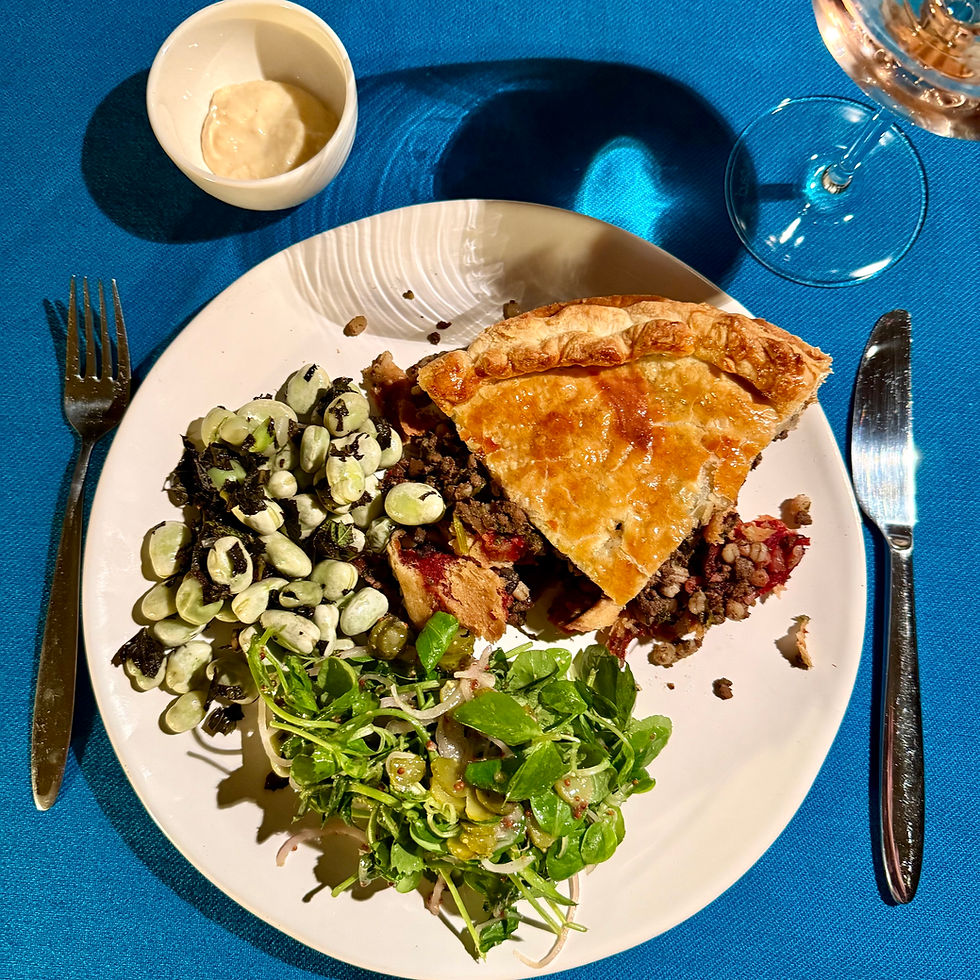
I am doing it here with minted broad beans and a very simple salad of lamb's lettuce, pea shoots and chopped gherkins and raw shallots with a simple mustard vinaigrette dressing.
After enjoying it for supper yesterday, I took a pie around to my oldest friend in the world and we kicked off the week by having it with the remainder of the pea shoot and lamb's lettuce salad, lightly buttered boiled baby potatoes in their skins, and her delicious chilled salad of sliced cucumber, raw red onions and avocado in a Greek yoghurt, mayonnaise and chopped dill dressing. It was glorious.
Traditionally this dish is served in warmer weather with salads and green vegetables such as steamed green beans, peas or broad beans. And the pie is served with creamed horseradish sauce.
In the winter, it was more traditional to serve it with potatoes and heartier root vegetables such as carrots, turnips or parsnips. A gravy would be made by pouring off liquid from the pot of simmering minced beef in the later stages of cooking and reducing this with butter, caramelised onions, flour and a sparing amount of nutmeg. This creates the perfect sauce for diners to pour over the winter shortcrust pastry pie lid.
Cooking Method
the barley, beetroot and beef pie
You can prepare your pie filling up to a few days before and store in the fridge. Either way, you need to prepare it well enough in advance to ensure it is fully cooled, ideally with a bit of time being chilled in the fridge before it goes into the pie case.
Heat three quarters of the oil on a low-medium heat. When hot, add the onions and sauté, adding the caraway seed a minute or so after. Cover and sweat for a few minutes
Add the celery and stir in. Re-cover and sweat for a few minutes. Then uncover and add the garlic. Once the aroma releases, add a dash of the beer—just enough to prevent sticking—re-cover and cook for about 6 or 7mins
When the onions and celery are notably softened, add the mushrooms. Cover and allow them to sweat for a few minutes, then stir in ensuring they are fully coated in the juices. Add a another dash of the beer, re-cover and cook for a further 5 to 6 mins, until the mushrooms have notably softened—the don't have to be fully cooked—and almost all of the liquid has cooked off
Add the remainder of the oil and, almost immediately, add all of the minced beef, breaking it up and pushing it towards the bottom of the pot to be browned in the oil and slowly mixing it into the other ingredients
When the beef is fully browned, add the remainder of the beer and about half of the beef stock. Increase the heat slightly so that it comes to a healthy simmer. Cover and simmer for approx. 5mins
Reduce to a low heat so that it simmers gently. Simmer gently for approx. 60 mins, stirring occasionally and topping up with additional stock to ensure it does not stick to the bottom of the pot
When the beef is cooked and the liquid notably reduced, add the caramelised onion paste and stir in. Cover and simmer for approx. 20mins more, stirring occasionally and adding salt as needed during this time
When almost all the liquid is cooked cooked off and the minced beef is soft and succulent, add the baby spinach, allowing it to initially wilt, then gently folding in. Simmer for a another minute or so and then turn off the heat. Add the curly leaf parsley and fold in, allowing it to merely wilt from the heat of the pot
When the beef has fully cooled, fold in the cooked pearl barely and season with the white pepper. Place to one side, ideally in the fridge
Bake your shortcrust pastry base. Line a greased pie dish/es with the pastry. Place baking paper on top of the pastry and into this places pie weights, baking "pebbles", uncooked rice or anything appropriate—I use washed large garden potting gravel—to weigh down the pastry and prevent it from bubbling up. Initially bake in an oven preheated to 200°C for 15 to 20mins. Then carefully remove the baking paper and weights and bake for a further 5mins. Remove from the oven and allow to cool fully
Once the pie base is cool, line the bottom of the crust with the sliced beetroot. Spoon in the beef and pearl barley filling. Roll out the pie lid and adhere to the base using the egg wash. Baste the lid with the egg wash and make a few holes in the top to allow the steam to escape. Bake in an oven preheated to 200°C for 30 to 35mins until the pie lid is golden. Remove from the oven and allow to rest
Plate and take to table with your desired side dishes
Alternatives
This is a dish that is shockingly easy to turn lactovegetarian. Simply replace the minced beef with the same quantity of soya mince or Quorn mince. Furthermore, sadly still unknown to a lot of vegetarians who try to whip up a "spag bog" in 30mins, soya mince achieves its potential when simmered slowly over a longer period with flavour-giving ingredients. Obviously replace the beef stock with vegetable stock.
Following the lactovegetarian lines, the only thing that prevents this pie from being vegan is the pastry. And, while I cannot comment with any expertise, I do know there are a lot of good shortcrust-like vegan pastry recipes out there.
I have never been tempted to create a pescatarian version of this dish because both the herb profiles and the cooking method do not lean in that direction. That said, meatier fish—such as salmon—and beetroot are a good combination. So I guess that's a future project.
Pairings
Beef obviously leans in a red direction and, indeed, middle-bodied German red wines work very well with this dish—Spätburgunder (Pinot Noir) and Dornfelder. On the occasion I learned to cook this pie we had it with an excellent organic Dornfelder from the nearest wine-growing region in the Elbe Valley. The problem is that Sächsische Schweiz is one of Germany’s smallest wine-producing regions. So, apart from the award-winners that end up on restaurant wine lists outside of Germany, most of it is consumed domestically. However, if you are heading in the red direction, I suggest sticking to lighter or middle-bodied red wines such as Côtes du Rhône, Mencia, Pinot Noir or high-altitude Argentinian Malbec. Move to heavier reds in the colder months such as the Spätburgunders and Dornfelders from Pfalz und Rheinhessen, Germany’s premiere wine region. Or, look to Cabernet Sauvignon, Shiraz or even an oaky Rioja when the pie is served with cold-thwarting root vegetables.
But, you probably already know exactly what I’m going to say: this dish is great with rosé wines when it’s wearing its summer outfit, served with salads. On this occasion—I only decided to cook the pie at the last minute after a conversation with my brother—it worked fantastically with Bodegas Aragonesas Solo Dry Rosé, a very dry, slightly citric and well balanced Spanish wine I found in the local supermarket offering great bang for buck. But, if you stick to rosés with the cojones to cut through the beef, you’ll be fine.
Since this is a German dish, beer is always an option. Though I have never had it with beer, my gut instinct would be to have it with a pilsner (Pils) or a Weissbier that pulls out the notes of the barley.
On the wagon? Try it with a chilled apfelschorle, the traditional German non-alcoholic spritzer of apple juice and sparkling water. Apple is traditionally paired with flavours such as caraway used in the pie, horseradish or the mustard used in the salad dressing. It works perfectly.


Comments