


Pasta with Romano pepper, courgette and black olive sauce
Updated: Aug 27
Pasta with Romano pepper, courgette and black olive sauce is a recipe from Sicily perfect for hot weather; easily digested. It’s a lactovegetarian sauce dripping with the additional flavours of onions, basil, white wine, oregano and ricotta—and a kick of peperoncini if you like your Sicilian spicy. But, it is often served with the addition of pancetta cubes if you want a little meat. Though it’s best slow-cooked, it remains very easy to make.

Open doors
I often get asked for pasta recipes that don’t involve tomatoes either by friends who can’t eat tomatoes or are simply bored with making endless tomato-based pasta sauces. I was looking through my father’s journals from his travels to find something that would work for me during recent unpleasantly hot weather and I came across this one that promised to kill two birds with one stone.
It’s not dated, but given the sequence of the journals, I reckon it's from 1966. He came upon it in sweltering weather in Palermo, in one of those places that have largely died out as a result of regulation and competition from home dining apps. Back then in Palermo there were numerous places that were not formal trattorias or osterias, but where local Cesarine would offer visitors to be fed in their homes for an affordable fee, not so much about making a profit as covering the costs of their own dinner with a budget for better ingredients. There was absolutely no menu or wine list and you got to dine on what the family living there were having for supper that evening, most often simple, regional food.
Popular with passing sailors, students, writers, journalists and assorted bohemians rather than tourists, these places were right up my dad’s cobbled street and he often sought them out. In addition to the possibility of an unexpectedly interesting dinner conversation with the family and the five or six other étrangers sharing the table, he also knew that he would have direct access to whoever had cooked the supper, should it take his fancy.
He describes how he came across this place, a former woodworking shop on the ground floor below the family apartment because the huge wooden doors were thrown wide open, a large wooden table set between old workbenches. A few family members were already sharing glasses of wine with two German students and a Portuguese sailor. The promise of eating almost al fresco on the hot balmy evening was enticing and he asked if they still had capacity for another guest. He was immediately invited to join.
He learned that that the Cesarina Signora Spadaro was still upstairs cooking the evening’s meal. Her son Marco poured my father a glass of wine and explained that there were likely to be a couple more people showing up—it was still fairly early—while his mother and aunt put the finishing touches to dinner. Fascinated by the place, my father learned from Marco that it had once been the workshop of the family cabinetmaking business but that when his father retired, he had taken over and moved it to more modern premises. Now it was his mother and aunt’s project. But, they had left a lot of the old tools in the workshop so that his father could potter about making things when bored by retirement, mostly wooden toys for his grandchildren. Overhearing the conversation, Signor Spadaro, at the far end of the table, smiled, raised his glass, and then went back to a conversation with another elderly gentleman, his brother-in-law.
In all, Signora Spadaro and her sister fed sixteen people that evening, my father, the students, the sailor, a local bachelor policeman (who “needed to find a wife to feed him properly,” according to Signora Spadaro), a Kiwi photographer, and assorted family members. And, of course, at the end of the meal, my dad got all the time he wanted to grill Signora Spadaro and her sister on the recipe for the pasta dish, which he had found particularly interesting because it did not have tomatoes in it. In Sicily!
Both women were delighted to have a paying guest so interested, who conveniently understood Italian, and talked him through it in detail as he scribbled it down in his journal—I can always tell when it’s a “live recording” because in these entries the recipe always comes before the story and Denton more frequently forgot to date them. Signora Spadaro stressed to my dad that to make it in the truly traditional way, it should have minced peperoncini added to the sauce, but that her husband didn’t like spicy flavours. She rolled her eyes and laughed: “How can he call himself Sicilian?”

Two paths
Here, I am doing this dish in two slightly different ways. One, the way the original was made, involves making the sauce vegetable base and then roughly puréeing it and adding the ricotta to turn into something more like a pesto. Signora Spardaro explained that she used a hand-turned mincer to do this to the vegetable base before mixing with the ricotta and finishing the pasta with the pancetta cubes, not the old method her mother used with a pestle and mortar. I obviously use a handheld blender. This is the version I usually make if I am serving this as a primo piatto as part of a larger meal, which is certainly never the case in very hot weather. My father records his delight that the secondo piatto was a simple dish of white fish baked with herbs because he was already full after the pasta…
But, I do love the texture of the vegetables in the base sauce, so I will often serve it as a lactovegetarian pasta dish without the pancetta and without puréeing the base before mixing in the ricotta and finishing the pasta in it. In hot weather, I particularly like this version because it is easier to digest without the meat, but the chunkier vegetable pieces give more of a psychological sense of having had a full meal without the digestion strain.
As with the plight of Signora Spadaro, you can choose to add the peperoncini or not. I usually do because I think it’s clear from what I publish that I like a bit of spice. But, I leave it out when cooking it for friends who don’t or cooking for kids not from spice-forward households. Mercifully, their numbers are dwindling in the UK as younger generations of parents brought up on spices introduce their kids to their delight at an early age.
I'm doing the sauces with two stalwart Sicilian pastas; spaghetti and rigatoni, the pasta that was used when my father first encountered it. These are my go-to pastas for this recipe, but many other pastas work well too. Your choice, though I advise avoiding narrow-gauge tube pastas like penne or macaroni, because it's hard to get the the relatively thick sauce inside them
Peter Piper picked a peck...
One of the problems is that Romano peppers have a lot of different names in different places—Ramiro peppers, sweet pointed peppers, Corno di Toro, shepherd peppers, etc.—and, as an American chef based in France recently reminded me, you can get both hot and mild varieties that look almost the same. For this recipe, you want the mild variety and for them to be fairly sizeable. I'm including a picture, not to plug this supermarket chain, but to give a sense of scale; the size of pepper you should seek out.

Take note:
This version is for 4 to 5 diners, depending on appetite and any side dishes. But, you can easily scale it up for a larger group—as long are you have a pan big enough in which to finish the al dente pasta.
I often make this dish in larger quantities than needed because it stores well in the fridge for a couple of days. It's also great cold as a kind of pasta salad dressed with a little extra virgin olive oil and chopped fresh basil.
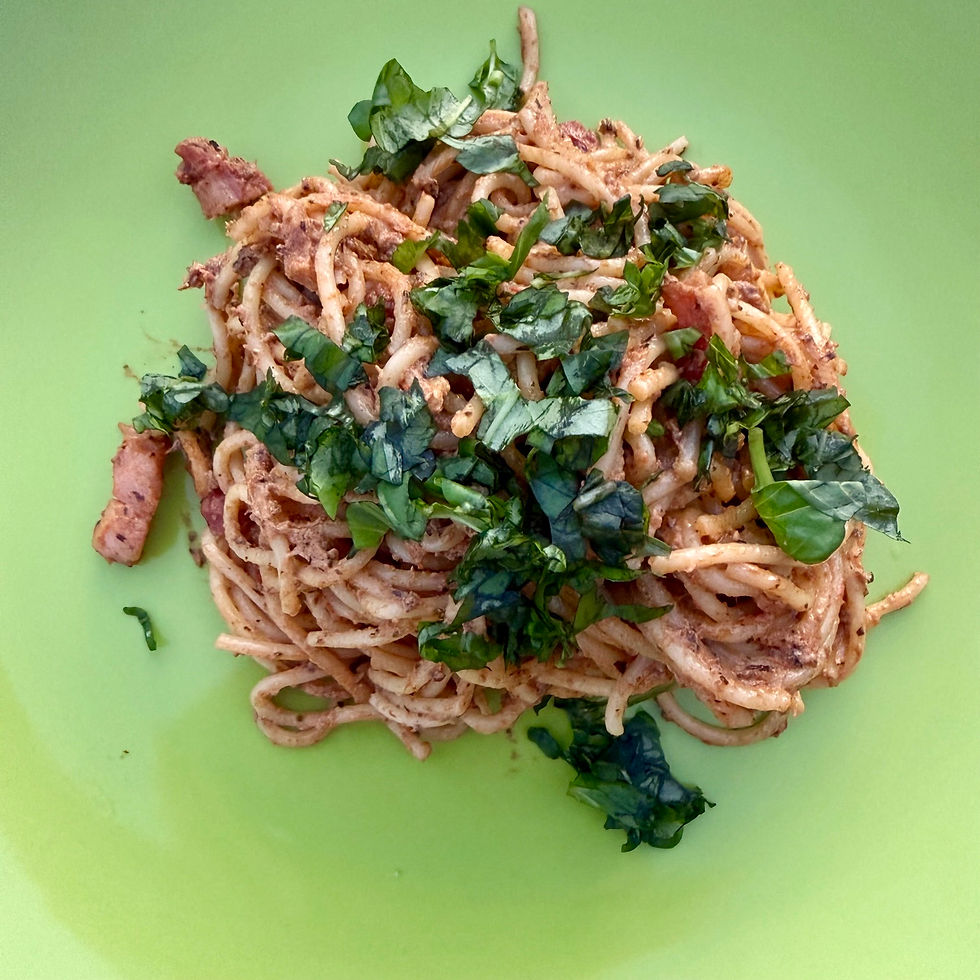
Please note that the images are indicative because I have used half of the vegetable base to make one version, and the remainder to make the other.
3 top tips to get this recipe right: |
|
|
|

Shopping list
for the pasta with Romano pepper, courgette and black olive sauce
Approx. 80-90g (dried) spaghetti or rigatoni per diner
2 large red onions (or brown); diced
3 large Romano red peppers; diced
1 large courgette; cut into small batons
Half a cup of pitted black olives, roughly chopped
500ml chicken stock (or vegetable stock)
2 or 3 dried bay leaves
4 cloves of garlic; chopped
1 or 2 tspns of minced peperoncini (optional)
4 to 5 tbspns virgin olive oil
Approx. 250ml dry white wine
2 tspns dried oregano
250g ricotta cheese
Approx. 200g pancetta; cubed (optional)
A generous clutch of fresh basil, chopped
1 tbspn of anchovy sauce (or Worcestershire sauce)
1 tbspn brown sugar (optional)
salt and freshly ground black pepper to taste
A little grated Grana Padano cheese for dressing (optional)
Side dishes
I almost always serve this pasta with very simple salads. Here I am using the same base of mixed leaves, including young Swiss chard and grated raw beetroot. In one, the salad is dressed with a caramelised onion vinaigrette. The other has added cucumber and sliced preserved artichokes with a dressing of extra virgin olive oil and blueberry vinegar.
If sprinkling with cheese in hot weather, I favour using softer, younger Grana Padano or Pecorino rather than Parmigiano Reggiano. However, more often I simply garnish it generously with chopped fresh basil.
Cooking Method
the pasta with Romano pepper, courgette and black olive sauce
Heat the oil in the frying pan on a medium heat. When hot add the onions and sauté for a few minutes, then add the Romano peppers. Stir in and sauté for a couple of minutes. When the peppers are fully coated—don't wait for them to actually soften—pour in all of the white wine and reduce to a low-medium heat
When the wine has almost cooked off, add the garlic, oregano, baby leaves and minced peperoncini (if using) and stir in. Once the garlic aromas release, pour in about a third of the stock. Reduce the heat so that the liquid simmers very gently. Cover and cook until the onions and peppers are notably softened—about 10 to 12mins
Add the courgette batons and fold in. Pour in another third of the stock. Cover and very gently simmer for about 25 to 30mins, stirring occasionally and adding dabs of stock as needed
When the courgette and peppers are fully cooked and soft, add the chopped black olives and anchovy sauce and stir in. Add any remaining stock, cover and very gently simmer for a further 10 to 12mins
When the liquid has notably reduced, add the chopped basil and fold in. Simmer, uncovered until almost all of the liquid has cooked off, seasoning with salt as needed. Adding the brown sugar at this point will assist the reduction. However, I usually do not use it and just allow a little longer cooking time
Now that the vegetable base is fully cooked, you have two options. The first is to add the ricotta and gently fold in, seasoning with freshly ground black pepper. Then add your al dente pasta and 2 or 3tbspns of the "pasta water" to the pan, finishing the pasta in the sauce. Plate and take to table
The second option is to remove the vegetable base from the pan to a jug or bowl. Add the ricotta and use a handheld blender to make into a pesto. At the same time, add a dab of oil to the unwashed pan and fry the pancetta cubes until they begin to crisp on the outer edges. Add the sauce back into the pan and stir in, ensuring that any fats from the pancetta are fully assimilated. Season with freshly ground black pepper and add the pasta and 2 or 3tbspns of the "pasta water" into the pan. Finish the pasta in the sauce ensuring it evenly coats the pasta. Plate and take to table.
Alternatives
Assuming you do the version without the pancetta, the original recipe uses chicken stock, but it works equally well with vegetable stock. What makes that version pescatarian is only the anchovy sauce. This is easily remedied by substituting it with mushroom ketchup. And, voila, you have a lactovegetarian version.
If you follow the principle above and don't add the ricotta, you can produce a very pleasant vegan dish. Sure, it's not completely the same, but still delicious, especially with rigatoni dressed with a little olive oil.
Obviously the version with pancetta cubes is suitable for carnivores. With this dish that is really about light summer dining, I have never had any desire to add heavier meats, though cold leftovers served with cold carved chicken breast as a salad are great.
Pairings
I almost always have this dish with white wines, even if the version with pancetta. It somehow fits with its light, summer vibe. I can't even think of many specific whites of note but a more general sense of it working with things such as Sauvignon Blancs, Pinot Grigio or a robust Catarratto if you want to balance it with something a bit more present. But, two wines I would recommend are Tenuta Santori Pian dell'Est Pecorino that has enough acidity to cut through the creaminess and Settesoli Arpeggio Catarratto, which offers great bang-for-buck. It is a wonderfully dry wine, but very well balanced, really good for hot summer weather when you don't want too much acidity.
But, if you prefer red, fear not. My dad was very impressed by the light-bodied red wine with which the entire meal was served, a Nerello Mascalese produced by a relative of Signora Spadaro. While he doesn't mention more detail other than to say he bought a couple of bottles to take away with him, I have had the pancetta version of this dish with Cellaro Micina Nerello Mascalese, which worked very nicely.
All of this said, I often end up cooking this dish when it is simply too hot for booze. My favourite non-alcoholic tipple with this one is to infuse still mineral water with lemon, basil and cucumber in the fridge for about twelve hours and then serve it in a pitcher with ice.


Comments