


Hungarian chicken pie
This Hungarian chicken in pastry is brimming with flavours of chicken, mushrooms and a less expected ingredient—gherkins—in a creamy, smoky paprika sauce. It's highly versatile. It can be done in the French style of en croûte, or as a large pie, or you can bypass the pastry altogether and serve it with noodles, rice or potatoes. But, is it really Hungarian?

Pickles pie
Gherkins are what triggered my passion for this Hungarian chicken pie. Pickles cooked into a pie? How curious. I was hooked. My grandmother would smile every time I asked her if we could have it for supper when visiting.
My grandmother, my mother's mother, had a passion for cooking, something of which I had no idea as a child. I would usually only see her once or twice a year, when my grandparents visited—and my father would show off his passion for cooking—or when we visited them because we were ordinarily hundreds or even thousands of miles from each other. And, when we did visit, my grandfather would inevitably whisk the collected grandkids off on trips into the wilderness or day trips visiting his favourite haunts in the city, returning in time for supper. Food simply appeared. I had no idea that my Grannie Dosh had cooked much of it herself. Until this chicken pie.
In my later teens, I learned of her passion for cooking. Because I asked. She was the kind of woman brought up within a life of discretion and diplomacy and rarely spoke about herself in company unless invited because she was usually the one asking others polite questions about themselves. But, when I asked—because I wanted to learn how to make this pie—she beckoned me into her pantry. From a shelf, she pulled out a heavy, well-worn tome; part scrapbook, part journal. Inside were hundreds of handwritten recipes and just as many cuttings from newspapers or magazines. Without even looking, she threw it open on the exact page where there was a cutting from a French magazine. It was definitely retro.
When I asked her where she got it, she couldn't remember—perhaps my father or uncle had brought it back for her or my aunt, who loved a bit of French cooking. However, she could certainly remember other details. She told me that in the early 1960s, as a kind of reaction to the failed 1956 Budapest Uprising, Hungarian cooking suddenly became fashionable in Austria and West Germany. Serving Hungarian dishes signalled one's anti-Soviet credentials. Later, in the early 1960s, when Paris had become home to many of the Hungarian students and intellectuals who had fled the Russian tanks, the French were not going to be outdone by Krauts.

Hungary rising
Rather than focus on the traditional Hungarian folk fare dished up in Vienna or Bonn, the French wanted to remind the world that it was their great chefs who had first made all things Hungarian—or at least French haute cuisine's fantasy thereof—a late 19th-century craze. French high society had delighted in the scandal of the Austrian Empress Elizabeth aka Sissi openly having an affair with a Hungarian count and decamping from Vienna to Hungary where she openly supported the Hungarian nationalist movement, direct defiance and insult to her husband the Emperor Franz Joseph. It was also technically two counts of treason: regal infidelity and because grumpy old Franz Joseph was also King of Hungary at the time. The French elite took great delight in knowing that reports of of their dining on dishes celebrating Hungary would cause immense chagrin to the musty Habsburg regime in Schönbrunn Palace in Vienna and their loyal servants. Parisian newspapers sold extra copies on the gossip: accounts of the Austrian ambassador storming out of a dinner party when Hungarian dishes were served; or enraged visiting Austrian officers being ejected from a high-end dining establishment where they threatened to kill the chef for his celebration of Hungarian culinary culture.
During the early 1960s revival, posh French restaurants blew the dust off archival haute cuisine recipes and things like fancy versions of poulet à la hongroise once again appeared on their menus. And popular women's magazines for "discerning ladies"—like the one from which the recipe in Grannie Dosh's collection was clipped—published simplified versions that could be revealed at bourgeois dinner parties.
Scanning the ingredients of the recipe, I could instantly see why this would appeal to my grandmother. There were ingredients in there that mapped straight onto the food traditions of this Germanic side of my family—caraway seeds, white pepper, cream and, of course, gherkins. Or in this case cornichons. After all, this was a French recipe.
A few days after I assisted her, learning to cook it myself, I was allowed to take the treasured collection to the public library to photocopy the recipes that caught my eye. I carefully placed these grainy black-'n-white copies in a cardboard folder in my suitcase so that I could add them to my own germinating collection when I returned home.
Even though I have kept my own book for decades, I rarely look at it. For one thing, there is simply not space to add anything new, which I now store digitally. And for another, I know most of what is in there by heart. But, a few months ago, I pulled it off a shelf, looking for another recipe completely and remembered how much I love it. I had almost forgotten about it and hadn't cooked it for ages. So, I resolved to give it a fresh visit.
Celebrating the evolving frauthentic
Just so no one is confused, there is little that is authentically Hungarian about this recipe. It is baked in layers of "lost in translation". It's my tweaking of a 1960s French recipe, itself a refraction of French 19th-century recipes exoticising Hungarian cooking through the lens of haute cuisine at a time when France had no doubts that its culinary traditions were the most important in the world.
Decades later, when I started to research food more seriously, and turned my attention to this beloved pie of childhood, it became easy to trace these reworkings. This 1960s poulet à la hongroise en croûte steals from the 19th-century haute cuisine recipe for "Hungarian chicken", a (mis)interpretation of traditional Hungarian csirkepaprikás (chiken paprikash). But, it also lifts from Sztroganov marhatokány, the traditional Hungarian version of Beef Stroganoff that deploys mushrooms and those gherkins that I so love that are not used in either the original Hungarian chicken dish nor poulet à la hongroise. And, just to make things even more confusing, by the late-1970s, poulet à la hongroise morphed into an even more simplified version than in the 1960s recipe; chicken cooked in a paprika-heavy type of ratatouille, usually with some creamy element added. And, certainly, not a cornichon in sight.
It became the French equivalent of the Anglophone world's chicken à la King. Both had started out as 19th-century haute cuisine and ended up being one of those easy recipes presented to the increasing number of working women feeding suburban families.

I too altered the 1960s recipe, mainly by reducing the excessive quantities of cream and butter of the original, but also in changing the quantity of paprika. The first time I made it using authentic Hungarian sweet smoked paprika using the quantities in the recipe I recoiled at the first bite. This was not the beloved pie of childhood! Then it dawned on me. In the 1960s and 1970s, what was generally available as "paprika" in Western Europe was the very mild—bordering on flavourless—paprika used extensively in German cooking. I always thought of it more as a food colourant than a spice... What kind of crisps do you want? I don't want the paprika ones because they taste of nothing!
I suspect that this is the type of paprika to which the 1960s recipe referred because as soon as I used Hungarian sweet smoked paprika in a third of that quantity, the magic returned. Incidentally, the other ingredient I chucked out was cochineal food colouring. Remember that? As the recipe explained, the mushrooms will turn your filling to a deep brown colour as they cook down. Apparently, the answer to give it more of an "authentic" Hungarian red was cochineal. I wonder whether Grannie Dosh put it in? Probably.
Weirdly, browning the chicken in a little oil—as opposed to butter—is part of the 1960s recipe that stresses not using butter for this. That didn't strike me as very French for that period, but I have stuck to this.
And, all this before we even get to the en croûte. As far as I could discover, Hungarian cuisine doesn't really have a savoury pie tradition....
Pie are squared
Although the recipe refers to "en croûte" throughout, the picture illustrating it was of a larger, single pie, something that would more usually be referred to as a "tourte" in French if the ingredients are savoury. This may have simply been an art direction decision; an attractive image of a pie with a large slice cut out to reveal its succulent (cochineal-laden) filling. But French is a funny old language and "en croûte"is a bit of a catch-all referring to anything clad in pastry. For example, this dish is also technically a tourte, but I've never heard the term used about it in Lyon.
My grandmother followed the example of the image in the magazine recipe and always made it as a single large pie. And I have largely done so too. But, my brain clings to little details that don't quite enmesh, equations that don't balance. So, at some point, I started experimenting cooking in more in the style of en croûte used to cook chunkier things, like salmon or the beef in bœuf Wellington, and I was very pleased with the results. It also came with the additional benefit that you can bake it on baking sheets and not have to mess about with pie dishes. And, for small households like mine—a one-person household for extended periods of time—the baked en croûte variety with a single portion of the filling, had other advantages. They freeze very well and are easily transported, like a Cornish pasty, making it a great lunchbox item.
I never make my own pastry for this recipe. I'm fortunate enough to live with easy access to a variety of good readymade pastries and I always use those. The original recipe calls of a traditional puff pastry, and that's what I'm using here for the individual en croûte version. However, from past experiments, I thoroughly recommend using a savoury shortcrust pastry if making it as a large single pie. Not sure why, but I find it a better option, especially in autumnal weather. So that's what I am doing here too.
With either pastry option, I usually dust a little smoked sweet paprika onto the top of the pie before brushing with an egg bath. This creates a nice aroma and dark colour while baking and a pleasant fleeting piquant note as you bite into the pastry. It's totally optional.
As a large pie in shortcrust pastry Baked en croûte in puff pastry
However, if even readymade pastry is to much of a hassle, steal from French 1970s poulet à la hongroise: the cooked "filling" works perfectly served with rice, potatoes or noodles, this last one being the closest to the way the Hungarian original is usually served.

Side dishes: from one frauthenticity to another
The 1960s recipe suggests serving the pie with either sautéd potatoes or buttery mashed potatoes with loads of cream, and steamed green beans or savoy cabbage. Obviously these work, but they are ingredients often used in Hungarian side dishes filtered through French dining traditions.
One of the things I noticed when eating at traditional places in Budapest and Győr is while there are plenty of delicious side dishes that work well with authentic Hungarian cuisine, I find a lot of them—in their traditional form at least—too rich or heavy with an already rich frauthentic pie. So while some of mine are a nod to the real deal, I am, literally, slimming them down: Hungarian sides dishes often use a lots of soured cream or thick tomato sauces that would be overkill given the filling.
Take note:
This pie feeds 4 to 6 diners as main course portions. If you have leftover portions, remove from the baking sheet or pie dish and wrap each portion individually in metallic foil before storing in the fridge where it will last well for 3 or 4 days. While it won't prevent the pie from inevitably drying out a little in the fridge, it helps when you reheat it.
When you come to reheat the pie, place the portions, still wrapped in the foil on a baking tray in an oven preheated to 175°C. Place a shallow bowl of water beside it or on a lower shelf. Reheat for 12 to 15mins, still wrapped. This prevents the crust from overcooking. Then open the foil and bake for a further 8 to 10min, or until fully heated all the way through.
If cooking in the single-portion en croûte format, you can freeze these in suitable freezer bags with as much of the air pressed out as possible. Reheat from frozen on a non-stick baking tray from frozen at 190°C. for about 20mins. If after 12 to 15mins, the top appears to be browning too much, simply turn them over. This one of the reasons I use an en croûte format with the "seam" on the side so that both top and bottom are fairly flat.
Another hack is that if you know you will have left over portions, bake in smaller two-person recyclable foil or paper pie baking trays. Those that you do not plan to eat within the next few days, freeze in their trays wrapped in clingfilm or a tightly wrapped freezer bag. Reheat from frozen at 190°C. for about 20 to 30mins, loosely covered with foil to prevent the tops over-browning. Remove the foil after about 15mins.
Please note the the version in which I am cooking it in the photos has different ratios of chicken and mushrooms from the recipe. This is because I had a lot of mushrooms that needed to be used. So I am using more mushrooms and less chicken.
3 top tips to get this recipe right: |
|
|
|
Shopping list
for the Hungarian chicken pie
Approx. 650 to 700g skinless chicken breast; (or thighs) cut into bite-sized pieces
2 medium brown onions (or red or white); diced
4 or 5 cloves of garlic; finely chopped
300g large (chestnut )closed cup mushrooms; (or a mix of mushrooms); thickly sliced
Approx. 4 tbspns unsalted butter
2 tbspns sunflower oil (or vegetable oil)
500ml chicken stock (or vegetable stock)
400g tomatoes, finely puréed (or use a handheld blender on tinned chopped tomatoes)
12 to 14 larger cornichons (or fewer medium gherkins); sliced vertically
A large clutch of fresh parsley; roughly chopped
150ml single cream
3 tspns sweet smoked paprika (or authentic Hungarian smoked paprika)
2 tspns caraway seeds
2 tspns white pepper, coarsely ground
Approx. 3 tbspns plain white flour; sifted
Approx. 350g puff pastry; (or shortcrust) store-bought or homemade
An egg (for the egg bath)
salt to taste
side dishes
puffy potato cakes Franciasaláta Salade tiède
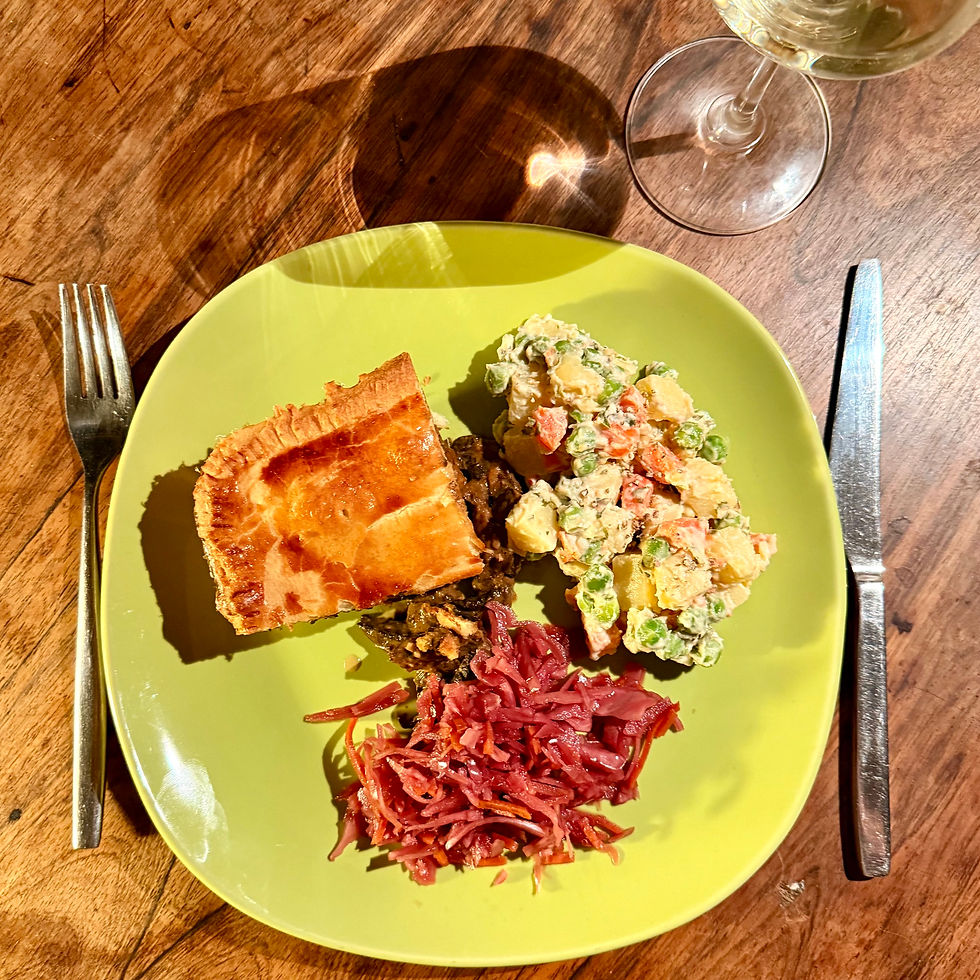
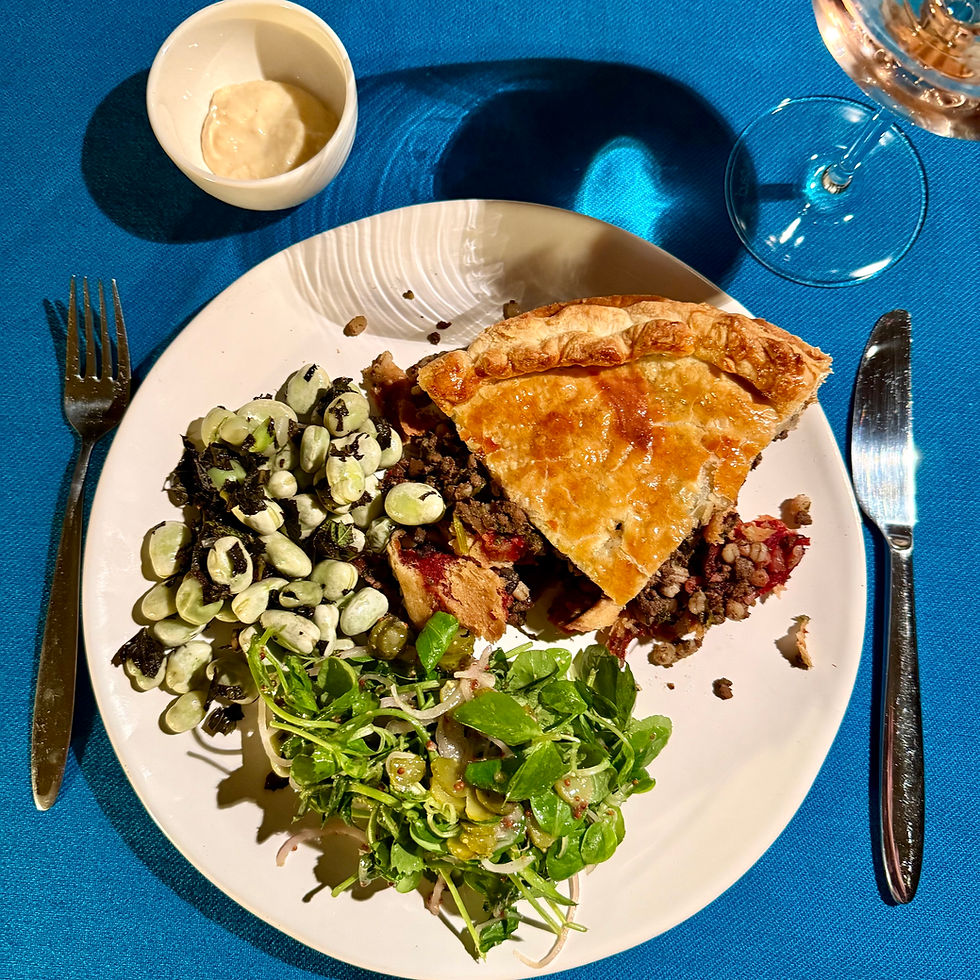
The images on this page show me serving the pie on two different occasions, each with two different side dishes. They are:
Franciasaláta - the Hungarian equivalent of Russian salad, which inevitably they call "French salad"; cubes of boiled potatoes, carrots, and peas in a creamy mayonnaise dressing. Sometimes it has boiled eggs or apple added, but I left those out
pickled red cabbage - a classic in a slightly sweet pickling brine. No, I did not make it myself but bought a brand I like
A salade tiède of steamed tenderstem broccoli, crispy bacon, chopped shallots and apple in a mustard and toasted pumpkin seed vinaigrette
puffy potato cakes - mashed potatoes, flour, chopped onions, garlic and parsley, white pepper and a little baking soda; shallow fried until golden brown
Cooking method
the Hungarian chicken pie
Start by preparing the chicken. Sift a little flour evenly onto a large plate. Place your chicken pieces on the plate. Season with a little salt, then sift a little more flour evenly over all of the chicken and gently pat down. Shake off the excess
In a large frying pan, heat the oil on a medium heat. Add the floured chicken to the pan and brown for 3 to 4mins, turning halfway through. Season with a little white pepper. If it becomes dry and begins to stick, add a little more oil. When the chicken has a healthy colour on all sides, remove from the heat and place to one side
Add the butter to a clean large pot with a lid and heat on a medium heat. Once the butter begins bubbling, add the onions and sauté, stirring regularly. When they begin to soften, add the garlic and stir in. Sauté together, stirring regularly to ensure the garlic doesn't burn: any signs of sticking, add a little more butter. When the garlic aromas release, add the caraway seeds and stir in. Cook, stirring, until the onions have browned
Deglaze using a little stock. Add the mushrooms and gently fold in, avoiding breaking them up. When the mushrooms begin to release some of their liquids, reduce the heat slightly, cover and sweat, stirring occasionally. Sweat for about 5mins
Once the mushrooms change colour on all sides—they don't need to be fully cooked, but nicely sealed—add approx. 300ml of the stock to the pot. Bring to a simmer, slightly reduce the heat, cover, and gently simmer for about 10mins
Add the paprika, tomato purée and 2tbspn sifted flour. Steadily stir as you slowly pour in the remaining stock until the flour has been fully assimilated without any lumps. Cover and gently simmer for 15 to 20mins, stirring occasionally to prevent sticking
When the sauce has notably reduced and thickened, add the chicken and fold in. Re-cover and gently simmer for a further 10 to 15mins, stirring occasionally. If, at any point the sauce appears to be thickening and reducing too quickly, add dabs of boiling water
Add the chopped parsley and fold in. Re-cover and gently simmer for 5mins
Uncover and add the cream, stirring in. You may need to increase the heat to retain an actual simmer while doing this. Keep stirring until all of the cream is assimilated fully
Cover and reduce to a low heat until barely simmering. Over the next 20 to 30min—it takes as long as it takes—stir regularly as you reduce to a thick, creamy sauce.
Add the cornichons and white pepper and fold in. Season with salt as needed. Slightly increase the heat and simmer, uncovered, as it cooks down to be genuinely thick, almost a paste—usually about 5 to 8min. Remove from the heat and cool fully
NB: I often cook the filling the night before and store overnight in the fridge before baking the pies. At the very least, the filling needs to be fully cooled before baking your pie/s. But for best results, if it is actually chilled in the fridge for 4 hours this really helps the pastry, which should also be chilled when it goes into a hot oven.
the pie/s
Depending on what approach you are taking, roll out you pastry and then either:
Line a greased pie dish/es with the pastry. Place baking paper on top of the pastry and add pie weights, baking "pebbles", uncooked rice or anything appropriate—I use washed large garden potting gravel—to weigh down the pastry and prevent it from bubbling up. Initially bake in an oven preheated to 180°C for 15 to 20mins. Then carefully remove the baking paper and weights and bake for a further 5mins. Remove from the oven and allow to cool fully.
Once the pie base is cool, spoon in the filling. Roll out the pie lid and adhere to the base using the egg wash. Sprinkle a little paprika over the lid, then baste with the egg wash, and make a few holes in the top to allow the steam to escape. Bake in an oven preheated to 200°C for 30 to 35mins or until the pie lid is golden. Remove from the oven and allow to rest
OR
Divide your pastry into the number of individual "pasties" you want to make. Roll these out into roughly rectangular shapes. Leaving enough of an edge for you to seal the pastry, spoon the relevant amount of filling onto one half of the pastry. Then, gently lifting from the opposite side, drape the pastry over the filling. Seal the pastry with and egg bath and and by pressing the edges together using two fingers of one hand, and the thumb of the other. You want to work as quickly as possible so that the pastry remains as cool as possible. I usually divide my pastry into portions then leave in the fridge, only taking out a portion at a time when I am ready to roll it out
Place onto a non-stick baking sheet on a baking tray. Sprinkle a little paprika over the tops of the pastries, baste with the egg wash, and make a few holes in the top to allow the steam to escape. Bake in an oven preheated to 200°C for 30 to 35mins or until the pastry is golden. Remove from the oven and allow to rest
In either case, once rested, serve with your desired side dishes or allow to fully cool to be eaten later.
Alternatives
This dish does present challenges for vegans and vegetarians. It intrinsically relies heavily on dairy products. I have, on various occasions, cooked lactovegetarian versions using Quorn fake "chicken" pieces in lieu of the chicken and these have worked best when first browned in a separate pan in the manner of the chicken—though they don't need to be floured—but only added back into the dish a the end, when the gherkins are added.
It is theoretically possible to make a vegan version—either with Quorn or additional mushrooms—but I do not have the experience or expertise to comment on either vegan pastry or the viability plant-based cream replacements to pull off a comparable consistency.
On the carnivore front, I have made very good beef versions. After all, about 50% of the filling is based on the recipe for Sztroganov marhatokány, the traditional Hungarian version of Beef Stroganoff. First, lightly brown bite-sized cubes of beef in a little butter in the pot in which you will cook the filling. Remove with a sieve spoon and place to one side, leaving all the juices in the pot. Add back into the pot once the mushrooms have cooked down, just before the stock is first added. But otherwise follow the same recipe. Use beef or vegetable stock rather than chicken.
Pairings
I find this very much a "colour agnostic" dish. After all, it is chicken, which lends itself towards whites. But, on the other hand, with it its earthy mushroom flavours and kick of smoked paprika, it works just as well with reds, as long as they are not too overpowering.
If going for whites, you want something with enough depth to take on the paprika and mushrooms. Needless to say, the original recipe suggests serving it with a dry tokai (tokaji), that unique Hungarian and Slovakian wine that is rich (and often sweet) made with grapes affected by noble rot. While I think this could work if you can find the right dry tokaji, it could also overpower this dish. I think it wiser to head in the direction of an Austrian or Alsatian gewürztraminer, still with some of that raisin-like note, but a little fresher. Given the huge French footprint in this dish, it's probably no wonder I really like Peter Weber Gewürztraminer Alsace 'Rosacker' and Trimbach Gewürztraminer Alsace with it. Both are from Alsace; as about as dry as a gewürztraminer gets—which is to say not particularly dry—but their relatively low acidity also works very nicely with the rich pie filling and hit of paprika.
On the red front, you want something medium-bodied, not overpowering, and I do certainly like this dish with the warmer sense red wine brings in autumnal weather. At the moment, all the oenology writers seem to be banging on about Hungarian Kékfrankos wines—call me cynical, but I sense there have been quite a lot of jollies to Hungarian wineries of late—a trope about which I am massively ignorant. But, in the spirit of celebrating the (supposedly) Hungarian nature of this dish, I gave it a whirl with a 2021 Weninger Kékfrankos Balf, which stood up nicely, if a little too tannic and acidic for my liking with this dish. Overall, I much preferred it with a Föranerhof Zweiglet from Italy's Alto Adige where those tannins and acidity were pared back. But you don't have to only go for the more obscure: there are plenty of pinot noirs/pinotages or even Australian Shiraz wines out there that would work particularly well with this hearty dish.
Okay, so maybe it is cultural programming but my basic "rule" for non-alcoholic drinks with any dish that has notable flavours of caraway is to always opt for an apfelschorle. The combination of apple and caraway wins through every time



Comments