


Prawns in tomato and artichoke sauce
Prawns in tomato and artichoke sauce is a simple—optionally quick—dish from the South of France near to the Italian border, and the culinary influences of both countries are evident. The flavour of sun-drenched tomatoes and red peppers shine through, a perfect lighter meal for warmer weather.

What's in a name?
I first came upon this dish in the beautiful French town of Menton near to the Italian border. And, if I had been served it away from the South of France, I would have guessed it was from coastal Italy, Liguria perhaps. It's nuances seem heavily influenced by Italian cooking, but when you look more closely, there are clearly those flavours in there of Provence or even the bouillabaisse of Marseilles. In fact, the whole process of first making the tomato sauce first is very reminiscent of a soupe de poisson à la tomate found in many regions of Southern France. But here, the oven finishing and artichokes somehow more immediately evoke Italian cuisine, as does leaving the sauce as a chunkier affair rather than blending it down to a smooth, thick soup before adding the seafood. The croutons, however, are pure France.
I was knocking about in Menton because I was curious to visit the place where the (in)famous English illustrator Aubrey Beardsley had spent the last years of his life and, indeed, where he is buried. I'd also heard about how it had been home to various successive waves of British artists and curious to learn more. After a day exploring and a couple of drinks with some friends and interesting locals down near the water, I realised that it was getting pretty late and that we were in need of food. Luckily, very soon we spotted a promising place.

I first savoured this dish as a fairly late supper on a hot evening as the sun was going down. But, given how busy they were, I knew I didn't have a hope in hell of schmoozing the chef. It was styled as a "bourride" on the menu board, but what I saw being served at other tables, delicious as it appeared, didn't look like any Provençal seafood bourride I'd ever seen, traditionally either a clear tomato soup or a creamy version thickened with aïoli. So I asked the waitress. Despite being rushed off her feet, she was very obliging and explained that it wasn't thickened with aïoli (garlic mayonnaise) but their French-Italian chef's take on things.
So, this isn't a dish from the horses mouth as it were but rather something I made notes about after eating it and a little research. And, the next year, when I first attempted it during a hot London summer, I concluded that my guesswork and research had pretty much nailed it, and it entered the repertoire of simple Mediterranean meals I cook frequently.
As lazy as you want
I am cooking this dish from scratch here as I often do when I have a few hours to spare—though most of that is getting on with other things and occasionally stirring a pot on a low heat. However, I also make the sauce in larger batches and freeze it because it makes a good sauce for later use with pasta or in numerous other dishes.
If you do know that you will have tomato sauce left over that you want to use in other ways, use vegetable stock and Italian anchovy or Worcestershire sauce and not the fish stock option.
I've listed brown sugar and balsamic vinegar as optional "if needed" ingredients for the sauce. They are reduction agents that will help your sauce to thicken more quickly if needed. However, I very rarely use them, preferring to make the time to reduce the sauce for longer on a very low heat.
It's ultimately a classic simple tomato sauce. So, if you are really pressed for time, you can sauté some onions and red peppers and add a decent store-bought sauce.
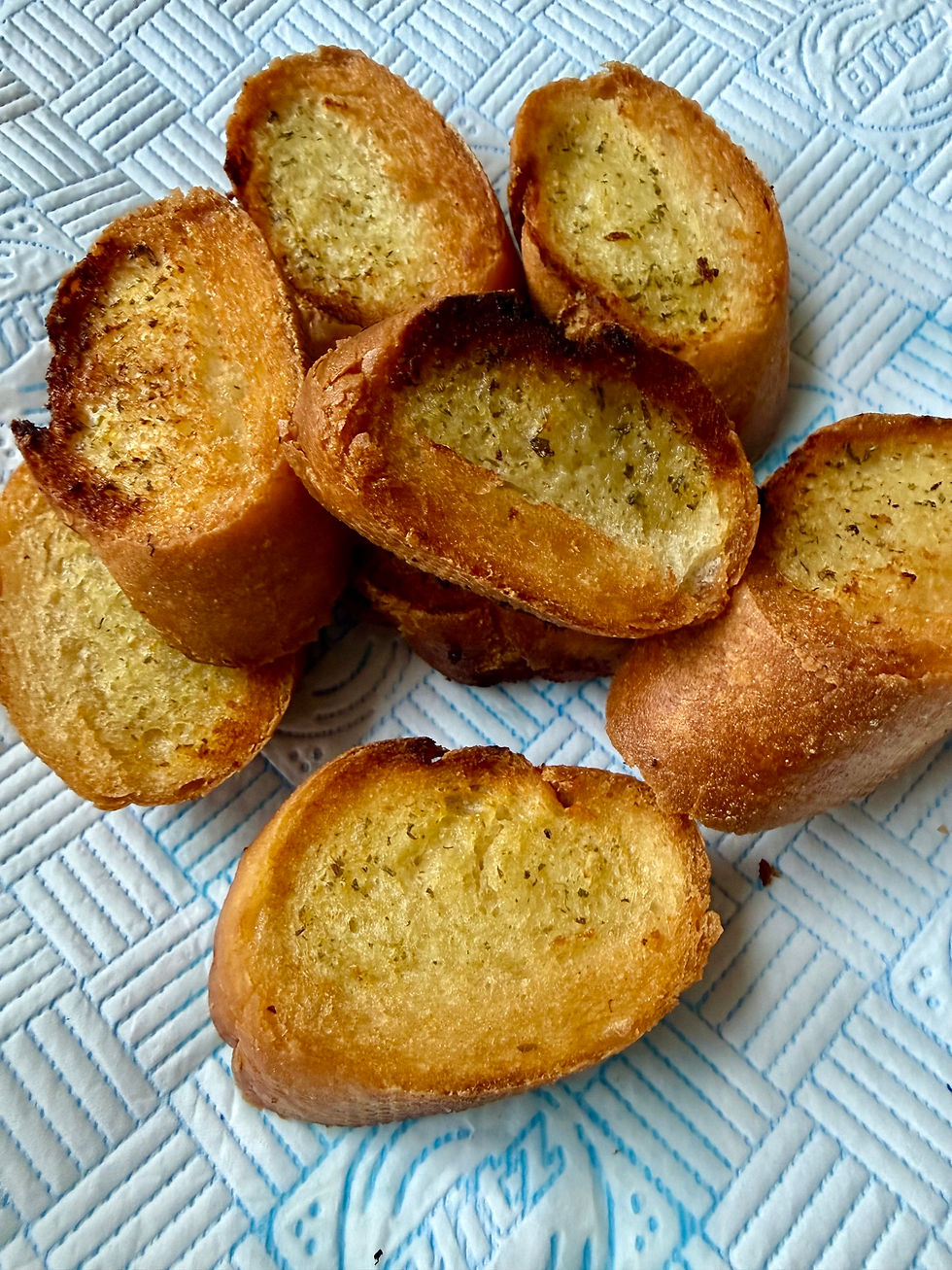
I am doing it here with croutons; proper croutons—not "salad croutons"—using a technique taught to me by more than one French-trained chef. There's a certain irony here: you start off by making something very similar to what gets called "garlic bread" in many Anglophone popular cooking cultures, but doesn't really exist in the classic French canon. For example, when a French chef friend visiting London was served "garlic bread" during a simple lunch in a laidback café, he asked me without a hint of classic Gallic sarcasm, "Why haven't they finished the croutons?" Make the effort and you will understand why. It's all about the texture contrast between the centre and the edges...
But, if you you don't want to make the effort to cook the croutons—or are counting calories—it works wonderfully with lightly toasted rustic bread rubbed with raw garlic cloves, an accompaniment you often find in the South of France.
Side-swiped
I'm doing it here with simple pan roasted vegetables as a side, just as I when I first experienced it, though I'm using a different selection of vegetables. The cauliflower is a significant addition: it really is great for soaking up the sauce. But, I am retaining the grilled red peppers and tomatoes because something I learned from the version in Menton is that tasting the same vegetables cooked in two different ways in the same meal really works well.
However, it's really up to you. Sometimes I serve it with a simple mixed leaf salad and that works fantastically too.

Take note:
In these quantities, this recipe will serve 2 to 3 diners, depending on side dishes. It scales up easily enough. While you can save it in the fridge and eat it the next day—cold, it is wonderful on toast or in a salad—because it's seafood, you can't keep it for long in the fridge safely nor can you freeze it.
I am cooking this dish in slightly reduced quantities and the images reflect that.
3 top tips to get this recipe right: |
|
|
|
Shopping list
for the prawns in tomato and artichoke sauce with croutons
Approx. 10 large king prawns per diner; half raw and shelled, half raw in their shells
2 medium onions, (red or brown); cubed
2 red bell peppers; sliced
1 tin (400g) chopped Italian tomatoes
Approx. 250g artichoke hearts; cut into large pieces; the kind preserved in oil (or fresh, cooked until tender and stripped back to the hearts only)
Approx. 3tbspns olive oil
1 tbspn concentrated tomate purée
4 cloves of garlic; finely chopped
150ml dry white wine
2 tspns dried oregano
2 dried bay leaves
A generous clutch of flat leaf parsley; chopped
250ml fish stock (or vegetable stock)
1 tbspn Italian anchovy sauce (or Worcestershire sauce)
Salt and black pepper, to taste
1 tbspn brown sugar (only if needed)
1 tbspn balsamic vinegar (only if needed)
1 baguette (for the croutons; optional)
Olive oil in which to shallow fry the croutons (optional)
for the pan roasted vegetables
½ a butternut squash; skin scrubbed, seeds removed and cut into thick slices
1 courgette; scrubbed and cut into slices horizontally
3 sweet red peppers; cut in half vertically; de-seeded
2 handfuls of baby plum tomatoes; washed
1tspn herbes de Provence
The juice and zest of ½ a fresh lemon
1 tbspn extra virgin olive oil
Salt and pepper, to taste
Cooking Method
the prawns in tomato and artichoke sauce
Cook your tomato sauce first. You can even do this days before and store in the fridge until just before it goes into the oven. In a pot with a lid, heat the olive oil on a medium heat. When hot, add the onions and stir in. Cover and sweat until they begin to soften. Add half of the wine, deglazing the bottom of the pot. Allow the wine to almost completely cook off. Then, add the garlic and stir in for a minute or so. Then pour in the remaining wine. Re-cover and sauté until the onions have notably softened, stirring occasionally
Add the red peppers and stir in. Cover and sauté for a few more minutes until the red peppers begin to soften. Once they start to soften—they don't have to be fully softened—add the tinned tomatoes and all of their juices and allow to come to the boil. Season with black pepper. Boil vigorously until almost all the excess liquid has cooked off
Dissolve the concentrated tomato purée in the stock, then add all of it to the pot and stir in. Bring to the boil and allow to boil vigorously from about a minute. Add the dried oregano and bay leaves and stir in. Cover and reduce to a low heat so that the pot is at a very gentle simmer
Depending on the heat, you want to reduce the liquid at a gentle simmer for about 1.5 to 2 hours in total, stirring about every 20mins or so (if you find ingredients are sticking to the bottom of the pot reduce the heat further)
After the pot has been simmering for about 40mins, add the anchovy sauce and stir in. After it has been cooking for about 1 hour, add the chopped parsley and stir in. After another 20mins, taste it—at this point season with salt as needed. Gently simmer until a fairly thick sauce. NB: if your sauce is not reducing, add the brown sugar and stir in, followed by the balsamic vinegar. Keep stirring with a wooden spoon until it reduces to the desired consistency. Remove from the heat and place to one side
If you have cooked your tomato sauce in advance and stored in the fridge, ensure it has fully returned to ambient temperature before it goes into the oven. In a fairly large oven-proof dish, spread out the prawns and the artichokes without them being piled on top of each other—a little overlap is fine. Spoon in the sauce, at first around and between the ingredients in the pan, then over the top of them. Bake in an oven preheated to 200°C. They will cook fairly quickly, the shelled prawns faster than those in their shells. After about 5min, turn the prawns, keeping a regular eye on them. As soon as the prawns are cooked i.e. pink on both sides, remove from the oven, but keep warm. NB: if you cook your tomato sauce and store in the fridge, ensure it has fully returned to ambient temperature before it goes into the oven
Plate or take directly to table, adding the croutons. Serve with your desired side dishes.
the baguette croutons
Make a classic"garlic bread" with your baguette; cutting it almost all the way through into thick slices and rubbing a little olive oil, crushed garlic and mixed herbs in between. Bake briefly in a hot oven but not wrapped in foil. Basically, you want the crusts to be fairly golden—because this reduces the time they need to fry—and the oil to have adhered the herbs and crushed garlic to the bread before they go into the pan
In a frying pan—I always use a fairly small one and do them in batches since they cook quickly—heat enough sunflower or vegetable oil for shallow frying on a medium heat. Once hot (make sure it's not too hot) fry these oversized croutons, turning once. Drain on kitchen paper towel. While you want the edges golden and crusty, you don't need to fry them as long as you would "salad" croutons
If you can, time it so that they are drained but still warm when you serve. But, if that's juggling too many plates, it's fine to do them some time before
Plate with your prawns in tomato and artichoke sauce and take to table
the pan roasted vegetables
With this selection of roasted vegetables, the total cooking time will be between 30 and 40mins, depending on how much charring you like and/or how thick your butternut slices are. Fortunately both this side dish and the main dish require an oven pre-heated to 200°C. So, it's fairly easy to time how you use the same oven to cook both dishes to be ready at the same time
In a roasting pan—I prefer to use metal rather than ceramic for this dish—lay out your slices of butternut squash, sprinkle with salt and pepper, spritz or baste with minimal olive oil and place into the preheated oven
After 15mins, turn the butternut squash and add the peppers and courgettes to the pan. Add a little more salt and pepper, a sprinkle of the herbs and re-spritz or baste. Return to the oven and cook for a further 10mins
Remove from the oven and turn all the veggies. If they look like they will be ready in the next 10mins or so, progress to adding the tomatoes, if not, return to the oven for another 5mins or so
Add the tomatoes around the edges of the pan—they will burst and leak juice—this time sprinkling with more dried herbes de Provence salt and pepper. Bake for another 6 to 12mins, depending on how cooked you want your vegetables
Remove from the oven and place in a bowl where you can gently mix them without breaking them up. Mix the lemon zest, juice and olive oil into a kind of vinaigrette. Dress while the vegetables are still warm or take to table in a serving dish with the prawns in tomato and artichoke sauce

Alternatives
By default a pescatarian dish, if you don't like or can't eat shellfish, it works very well with a broad rand of white fish fillets from cod to haddock or hake. When doing it with white fish, I find it best to sear the fillets in a hot pan with barely any oil or butter for about a minute or less on each side, depending on the thickness of your fillets and whether you leave the skin on or not. This helps retain the integrity of the fillets before you place them in the hot oven with the artichokes and sauce.
The best vegan option I have tasted so far is to replace the anchovy sauce with a mushroom ketchup or a vegan Worcestershire sauce when creating the tomato sauce. Then, don't cut the artichoke hearts (and obviously increase their quantity) but bake them in the same way in the oven in the tomato sauce. It really is delicious.
Carnivore versions that I find work well for those who insist on meat are to use chicken breast fillets wrapped in Serrano ham that have been grilled so that the chicken is almost cooked, the ham already a little crisp or small pork medallions that have also been pan cooked until almost done. With either of these, finish in the oven with the artichoke hearts and tomato sauce. In the case of meat versions, because they need to cook longer, the sauce will bake to be more solid than with this seafood version, which is fine. However, to prevent it drying out, cook at 180°C until the chicken or pork medallions are optimally cooked.
Pairings
This is a dish—one I almost always cook in the summer—with which I think rosé wines are the best option. I think it's because many rosés work well with seafood in fairly thick, herby tomato sauces.
On this occasion I found it worked very well with a Maison Fortant Réserve Rosé 2024, a wonderfully dry and smooth wine, and, better still, alarming value-for-money for a French rosé of this quality. However, my all time favourite with this dish is Laibach 'The Ladybird' Rosé, an organic Cape rosé made with indigenous Pinotage varietals that is full of fruity freshness with a surprisingly smooth finish, making it adaptable to a broad range of dishes.
If you'd rather stick to whites, I recommend Clos Sainte Magdeleine Cassis Blanc or Le Jade
Picpoul de Pinet 2024—most vintages are good, but this is particularly good. And, again, both of these wines are moderately priced. But, there are plenty of white wines that work with this dish. Needless to say, I head towards Picpoul de Pinet, Riesling, Albariño or Viré-Clessé on the white front. Sure, different regions and different grapes, but all share that certain balance of acidity and teetering on the the edge of a fizz...
This is also one of those dishes that works well with light, refreshing red wines from the Italian Alto Adige that are meant to be served chilled. My personal favourite is J. Hofstätter Steinraffler Lagrein Alto Adige 2019, not particularly cheap, but well worth it.


Comments