


Butternut and sweet potato tart
This lactovegetarian butternut squash and sweet potato tart was one of the first recipes I ever created, way back in the Dark Ages when I was still a teenager. With its creamy, slightly sweet filling balanced with herby onions, peppers and black olives, it immediately proved a crowdpleaser that I've dished up to successive generations of plant-based dinner guests.

A school for tarts
Recently I've been thinking a lot about recipes that I could share with a filmmaker friend and her vegetarian family. More specifically, I've been thinking about recipes she or her husband might enjoy cooking with their teenaged daughter, now of an age to have informed opinions of her own about food. This one came to mind because I have a lot of fond memories of it, a recipe I cobbled together when I was roughly the same age as my friend's teenaged daughter.
As I headed into my final year of school, my father thought that I would benefit from a household of my own, learning the skills for the adult world of independent living and, importantly, somewhere I could focus on my studies without the distractions of sibling spats or being driven crazy by my mother. And, better still, far closer to my school.
A place of one's own? Show me the teenager who would object...well, at least in my day. These days I hear so many friends complaining that they can't get their kids out of the nest, even with the promise of financial support, because they don't want to do their own laundry or learn to cook for themselves. One of the couples I know, determined to enjoy early retirement, secretly bought an apartment in Berlin, leaving their two twenty-something sons in the London family home. "It's the only way they're even going to learn to be grown-up," my friend said when revealing their plan a few weeks before they departed. But, I digress...
However, elation gave way to suspicion. My new house turned out to be the house in which my great-aunt had lived for many decades. Well, technically, she was my grandmother's cousin, but we always referred to her as Great-Aunt Helen. She was a lovely woman, a feisty and fiercely independent lady who had kept a military hospital in Egypt in shipshape during WWII and later devoted much of her life as a very hands-on trustee of an organisation that supported disabled and traumatised veterans of the Western Desert Campaign. A frequent guest at dinners or the displaced tradition of a family Sunday roast, I always looked forward to her joining us and made certain to be seated next to her so I could grill her, fascinated by her life experiences. I liked her very much, and she me.
Some months before, Helen had suffered a series of strokes requiring full-time residential care. It was touch and go as to where she would be able to return to independent living but a more recent devastating stroke had effectively ruled that out. I accused my father of only being concerned with family property, of seeing me as a convenient guard dog, not being concerned with my independent living skills at all but simply a stopgap while he figured out what to do with the house. How could I possibly feel comfortable as an intruder in the house my grandmother had enabled her cousin to make a home since the 1940s?
When my pouting subsided, my father, who also respected her immensely, said: "That's exactly why. You're the only one from our mob I can trust to not run riot through her home as long as there is any possibility that she may still return." It was at that point that I realised he was still in denial despite my mother's literally clinical clarity that Helen would not return. Seeing how much her circumstances caused him pain, I stopped being a little diva.
And, so I decamped, to a house furnished with astounding 1930s design. Armchairs with walnut marquetry worthy of a Hollywood screen goddess, beautiful Edwardian baths, and, above all else, a massive dining room with views over the garden and a table that seated 10, even before you messed about with the extension...
A friend of mine moved in with me—she was also heading into her final year of school and desperate to escape cloying parents. I understood why when they, despite an acrimonious divorce, turned up as a united front to check sleeping arrangements before agreeing. Irritated, my friend said, "You do know that I'm a lesbian and he's gay, right?"
"Yes, darling, I know," said her mother as if she were actually acknowledging the meaning of her daughter's words. "But we must be responsible parents. How do you think I would feel when I go back to Switzerland next week if I weren't sure you were safe?"
And so pretend grown-up life began. We'd be studious and domestic during the week, save for Wednesdays when my friend's girlfriend would come over and we'd make good use of the Art Deco cocktail trolley. And, on the weekends, it was a bit like an old-fashioned house party. There was was plenty of room to accommodate guests, other sixth-formers negotiating freedom with their parents. Our dinner parties and soirées became the must-have invite amongst fashionable kids that a mere two years earlier had treated as geeky lepers.
In the underground clubs we frequented on the weekends after these dinner parties—clearly underaged but none of the club owners giving a s**t because we, with a high ex-pat headcount, brought the best music straight from London—we arrogantly revelled in people schmoozing us to be invited to one of the dinners.
And so, finally, back to the food. Almost all of my friends were vegetarians or pescatarians (the word didn't even exist back then). The huge old-fashioned kitchen in the airy antebellum house became my cooking laboratory. At this time, most of what I had learned to cook had been taught to me by my father. So, the whole French, Italian and Cantonese segments were well covered. But, if I were to serve up vegetarian food worthy of my wonderful friends, I was going to need to up my game on the veggie front—remember, they turned up in vintage cut-on-the-bias 1930s evening dresses for these dinners...
The inspiration came with the house. A mere 50m from the service door, the kitchen garden delivered up a bounty of delectable produce. Despite Helen's hospitalisation, my father had been certain to retain the gardener, a surf-hippie dude called Adam—my dad didn't want me taking the garden on when I had studies on which to focus. A vegetarian himself, Adam went over an above on the produce when he realised that the new regime might actually have some demand for other additional "herbal" crops he was more than capable of nurturing in hidden parts of the garden.
Above all else, it was his butternut squash and flat white pumpkin that was responsible for the birth of this dish. They had been amongst my favourites since childhood and I really wanted to create something special with them.
Sweet and creamy enough
In this filling, the flavours are fairly sweet. In fact, I sometimes use it as the basis of a dessert version made with cinnamon, nutmeg, sultanas and sliced red cherries baked in puff pastry.
So, it’s useful to view it as a Meccano set in which you can adjust the levels of sweetness through a range of ingredients. For example, substituting the sweet potato with celeriac, potato, parsnips or swede, if you so wish, but ever mindful of water content. For example, the water content of celeriac means your filling can become too liquid when baking. Therefore, always use a combination of celeriac and potatoes and add a little extra flour, etc.
More importantly, it’s worth thinking about both the side dishes with which you serve it and those veggies in the bottom layer of the pie. Here, for example, I’m using red bell pepper because it was the most successful crowd-pleaser with kiddies in Edinburgh. But, when cooking it purely for myself, I favour green bell pepper because its slightly bitter flavour brings greater contrast.
You have a lot of scope with the dairy. Here it’s mascarpone—again the crowd-pleaser. But my personal favourite is Quark, which reduces the sweetness and is particularly good if you want a firmer texture—it's used in a lot of German baked cheesecake recipes. However, bog-standard cream cheese or ricotta work well too. But, avoid cottage cheese, yoghurt or fromage frais. These can become separated or exude too much liquid in the baking.
I think rice flour works best in terms of thickening the filling and keeping it creamy without being obviously present, though plain wheat flour works perfectly well too. Avoid gram flour (too present as an obvious flavour) or almond flour, which definitely takes it in the pudding direction.

Upper crust
Or not. As stated in many places on this site, I rarely make my own pastry these days when excellent readymade versions are readily available in many locations. Obviously, I did back when this tart came into being and it should be a classic shortcrust pastry by default. However, you can also choose to do it with a puff pastry if you want it to be lighter in general. I sometimes opt for this when making it as individual tartlets as a starter.
Don’t finish this tart with a full lid of pastry. It will defeat the purpose of the onions. In fact, you do not need to put any pastry on the top of this tart, treating it more like a quiche or savoury flan. But, if you opt for pastry on top, keep it restrained. Even though I have one of those nifty pastry lattice cutters tucked away in a drawer somewhere, I always default to a more modernist iteration of little squares, circles or rectangles plonked on the top and and brushed with an egg bath before finely grating a restrained amount of cheese over the top before it goes into the the oven.
Here, I’m using Parmigiano Reggiano that, together with aged Grana Padano, Manchego or Ossau-Iraty are the obvious ways to keep this within the whole Mediterranean vibe. But very mature Cheddar works really well too. It's a great dish for using that cheese that’s beyond its obvious best for sandwiches or on its own, has turned a little hard.
Whining about wine
Some people have asked me why wine appears in so many of my recipes. And my answer is usually a question: "Are they recipes with onions?"Of course cooking with wine is about flavour but, especially in Italian cooking, white wine's unique ability to soften onions enabling them to assimilate more easily into sauce's is age-old kitchen wisdom. The wine is listed as optional on the list of ingredients here. If you would like the onions to "blend" better with the peppers and olives—as I do—and be more of a contrast to the baked onions on the top of the tart, use the wine. If not, no problem.
I'm periodically reminded that a lot of people still have misconceptions about wine (or other alcoholic beverages) in cooking. Given how much concern some parents have about their children and are prescriptive about what the should or should not eat, I'm surprised when I encounter someone who doesn't know that all the alcohol cooks off: you're kids aren't being plied with liquor. The second—neurotic in my opinion—concern is that the taste of wine in dishes will somehow give their children an early appetite for booze. No, dahlings, it's peer pressure that does that.
Breaking news! If it actually tastes like wine, someone hasn't cooked it properly. Apart from a very small number of dishes where you want the alcohol's flavour present—such as certain types of beetroot soups served chilled with vodka—wine's flavour in cooking does not and should not taste like a glass of wine.
And, while we're on the subject, I'm not sure which clever wine merchant started the meme amongst many British TV chefs that you "shouldn't cook with wine you wouldn't drink". What an ingenious way to spread the myth that leaves the English middle classes thinking they need to be shelling out on good wine to go into the pot. It's nonsense. For one thing, it would cause laughter among Italian women—many of whom are amongst the best chefs I have ever encountered—all of whom have consistently taught me that you don't want to waste the good wine in the pot.
As with a lot of other myths about cooking, such as the rubbish about "wet risotto" or the insanity of putting everything into the wok at the same time with Chinese cooking, I think it's a very British misconception that stems from not having great language skills, combined with the inferiority complex many British chefs training in the 80s had—now the de facto font of knowledge for younger British chefs—when setting out to show credible mastery of French cooking in particular.
If they had understood more accurately, they would know that the French, Italian or Spanish guidance on using wine in cooking is qualified not one-size-fits-all. For example, if using a lot of wine that will form the basis of a sauce for a delicate dish like pan-cooked sole, then, yes, definitely use good quality wine because it will be more present as a flavour. This is a general "rule" for quickly cooked sauces that use a lot of wine combined with dairy such as cream or butter (oh, those Frenchies!) because poor quality wine can leave an undesired sourness whereas good wine heightens the silky, smoothness of the sauce.
But, if softening the onions or adding flavour to beef in sauces and oven-cooked dishes that will simmer or bake for hours, the quality of the wine is not that important since it will be utterly assimilated into the other ingredient flavours. That's the case here.
So, if you do opt to use the white wine in this dish, as I recommend, you're fine using the cheap stuff from the local supermarket... assuming you'll use the rest for cooking and not serving at table.
Take note:
There are two stages to baking this tart. The first is baking the pastry shell and waiting for it to cool fully. The second is making the filling and baking for a second time. I'm showing the recipe in the order I make it, but you can do so in a slightly different order if you prefer. The one thing I advise, however, is that you don't mix your filling too long before baking in the oven because it definitely is lighter when baking quite soon after you have whisked air into the mixture.
While this dish will last well in the fridge for up to 3 days, it does not freeze well.
You can serve this dish cold, in the manner of a quiche, and I sometimes do that when serving it as "party food"—some have told me they prefer it this way. But overall, I prefer to reheat leftovers in the oven. All up for grabs.
This version is for 3 to 4 diners, depending on appetite and any side dishes. But, you can easily scale it up for a larger group.
The images here show me cooking a 2-person version using half the quantities of the key ingredients in the recipe below. But, obviously you need to use as much pastry as you need to line your pie dish.
3 top tips to get this recipe right: |
|
|
|
Shopping list
for the butternut and sweet potato tart
1 medium butternut squash; quartered, boiled until fully tender; seeds removed (tip to novices: scrape the seeds out after boiling when they come away easily)
2 medium sweet potatoes; baked in their skins
250g mascarpone (or other soft cheese; see above)
4 medium onions; two chopped and two thinly sliced into onion rings
A large red bell pepper (or 2 sweet red peppers); roughly diced
Approx. ½ a cup of pitted black olives; sliced
A large clutch of fresh flat leaf parsley
3 cloves of garlic; very finely diced or crushed
3 tspns Mediterranean-style mixed dried herbs (basil, thyme, rosemary, marjoram, parsley, and oregano)
2 tbspns virgin olive oil
Approx. 150ml dry white wine
A small amount of finely grated hard cheese (optional)
Shortcrust pastry; enough to make the base of your tart
A small amount of unsalted butter (to grease your baking dish)
1 egg; for the egg wash (optional)
salt and pepper to taste
Side dishes
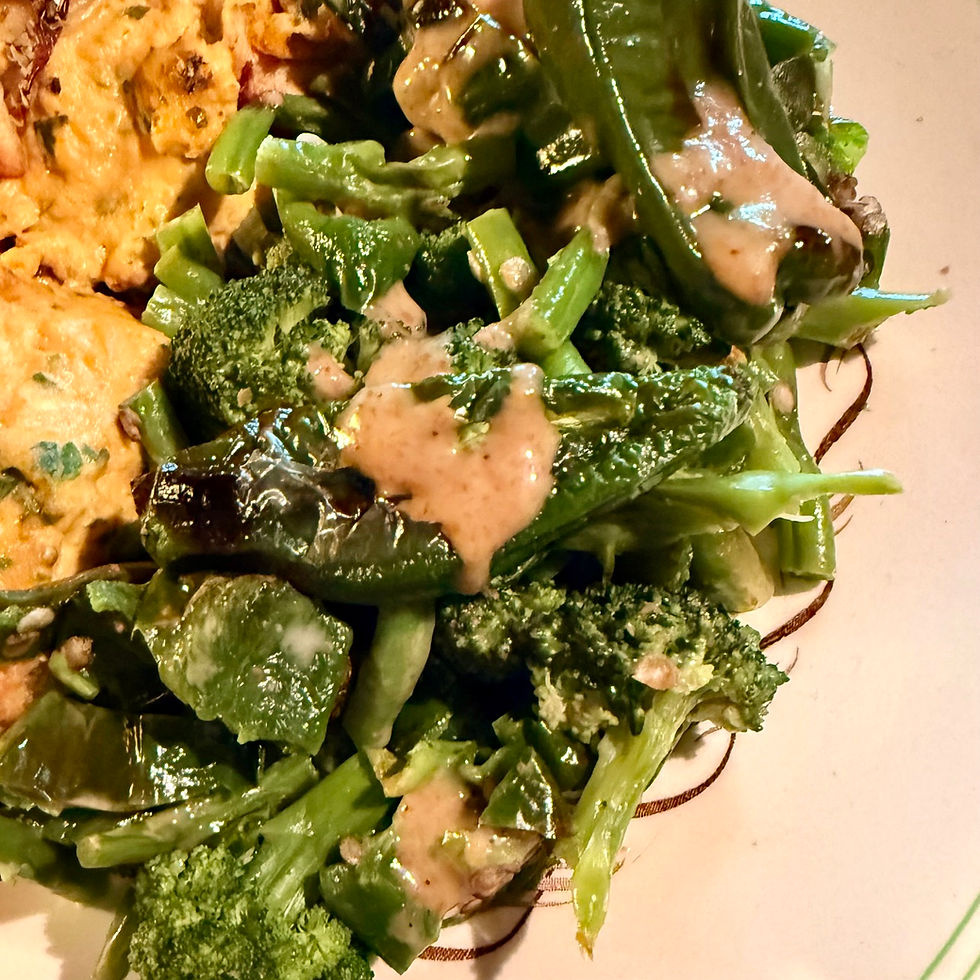
I'm serving it here with a side salad of broccoli, fresh green beans and grilled padrón pepper dressed in a traditional Japanese sesame dressing, which works perfectly in this fusion scenario. And I'm serving it as a "leftovers" lunch with a salad of raw courgette and cucumber with a mustard dressing and a garniture of fresh leaves. NB: when making salads with raw courgette, mix in the dressing about 20mins before serving because is has a beneficial "pickling" effect for the texture of courgettes.

The main thing to consider here is how the main course is fairly sweet. Thus, the kinds of side dishes I think well are:
Salads with bitter or peppery leaves —endive, rocket, frisée, etc.
Steamed green beans, green asparagus, mange tout, broad beans etc.
"Scandinavian" slaws— thinly sliced raw cabbage with mustard-based dressings; no carrots or mayonnaise
Cooking Method
the butternut and sweet potato tart
Roll out your pastry, and place in a lightly greased pie dish, pricking a number of slits into the base to prevent air bubbles. Bake in a pre-heated oven at 200°C for approx. 15mins or until the pastry is cooked, but barely turning golden. Place to one side and allow to cool fully
Spread your thin onion slices out on a plate so that they do not overlap. Microwave, uncovered, on full power (900W) for 2mins. Place to one side without disturbing them
In a frying pan, sauté your onions in a little olive oil on a medium heat. When they start to soften, add the red peppers and mix in. As the peppers also begin to soften, add the garlic and stir. As soon as the aroma releases, pour in half of the wine, allowing it to cook off, stirring occasionally. When the liquid has cooked off almost entirely, add 2tspns of the mixed herbs, and the olives. Stir in and add the remaining wine, reducing the heat slightly so it cooks off less quickly. When the onions and peppers are fully softened—the olives should remain firmer—and the wine has cooked off, season with salt as needed. Remove from the heat and place to one side. Allow to cool fully before adding to the tart
Add the parsley to a mini chopper or food processor. Chop this first so that you don't end up with large pieces in the filling. Add the butternut squash and sweet potatoes, scraping out of their skins. Add a little salt, and chop until a fairly smooth mash
Add the mash to a mixing bowl. Using a whisk or hand-held beater, mix in the mascarpone and rice flour until you have a smooth, fairly creamy mixture. Taste and add salt to taste. Finally, add the baking powder and mix in. NB: If you make your filling some time before, store in the fridge and wait until just before you add it to the tart to whisk in the baking powder
When your onion/peppers mix and pastry case are both fully cooled, spread the onions, olives and pepper into the case to form a thin bottom layer. Gently spoon in the creamy filling and spread out evenly
Cover the top of the tart with the onions in a single layer. Baste or spritz with a little olive oil (optional). Sprinkle over with 1tspn of the mixed dried herbs (or cracked black pepper if you prefer). If you wish—it's not essential at all—place a lattice or small decorative elements of pastry on the top of the tart, but ensuring that much of the surface of the onions is exposed.
Baste all the exposed pastry with an egg bath. Sprinkle over with a small amount of hard cheese (if using). Bake in the middle of a preheated oven at 200°C for approx. 30mins or until the pastry (and cheese) begin to turn golden brown
Allow the tart to cool briefly—the longer it cools, the less light and fluffy the filling will be as it settles. Cut, plate and take to table with your preferred side dishes
Alternatives
This is a lactovegetarian dish. In theory it can be turned into a vegan dish by using vegan pastry and vegan soft cheese/cream substitutes. I, however, cannot vouch for how well these would work since I have never made this tart using them.
I have not—and will never—attempt a pescatarian version because I have yet to find a fish or seafood that works well with butternut squash or pumpkin cooked together in the same dish. Side dish, maybe.
For obsessive carnivores, you can make a number of meat versions of this dish. My personal favourite involves putting a layer of grilled crispy bacon into the bottom of the tart (underneath the onions, peppers and olives) and a layer of raw bacon rashers under the onions on the top of the tart. Another option that works well is folding cooked pancetta cubes or large bacon lardons into the filling mixture just before layering into the tart.
Pairings
It's a long time since I last cooked this recipe, so I'm afraid that I don't yet have any very specific recommendations. But one thing I do know is it is very much a dish that works with either red or white wine. What I do remember is that with either—or indeed beer—it works better with "lighter".
Because the flavours in this dish are fairly delicate and sweet, if going for white wines, the drier, the better. I know that I also think it works better with smoother wines such as (dare I say it) Pinot Grigio or a fresher Pecorino—I've just had it with a quotidian supermarket Pecorino that worked very well. Saying that, I also remember it working very well—cutting through some of the sweetness—with those crisp Rieslings and Albariños that teeter on the edge of having almost a fizz.
With reds, I've always headed for softer, medium-bodied Côtes du Rhône or a Pinot Noir/Pinotage. I haven't really been more adventurous, because both have worked consistently well.
For some reason I remember disliking rosé wines with this dish—and, God knows, some pretty good ones would have been served to the veggie rosé queens a my youthful dining table—and I suspect it has something to do with the butternut squash. I could have just been on an anti-rosé tip when I decided this (it happens) but I have much more recent experience of finding butternut squash and rosé a mismatch with other dishes.
With beer, definitely stick to IPAs or "fresh" lagers on the whole. But there are two curve balls: Duvel (not Vedett) and that workhorse Guinness. No clear idea why they work. They simply do.
My tip for the best non-alcoholic options: sparkling water with a little fresh lemon juice or other non-alcoholic drinks that have a strong note of lemon, lime or cranberry. This acidity/neutrality is a nice balance to the sweetness of the butternut and sweet potatoes.


Comments