


Linguine with crab, peas and lemon
This linguine with crab, peas and lemon, and more besides, is the perfect dish for hot weather. With its notes of fresh herbs and healthy ingredients, it's fully satisfying yet easily digested. And, it is also both quick and easy to cook when temperatures mean the last thing you want is to spend time slaving over a hot stove.

Design for lunching
I came across this dish in a friendly family-run ristorante in Nervi while knocking about between a creative direction work gig and heading off to meet my partner and a friend for a little Ligurian holiday. Once an independent fishing village surrounded by the estates of the landed gentry, today Nervi is part of the metropolitan area of Genoa.
Only twenty minutes down the coast from central Genoa, it has a rich history with a series of 16th-century coastal fortifications, a picturesque harbour and an ancient port town where, a number of historians argue, Christopher Columbus was actually born. And, while the beaches and seafront certainly get busy with Italian tourists during the warmer months, it's definitely a better option for experiencing the unique Ligurian coastline than the tourist hell of the famed towns of the Cinque Terre.
More importantly, if you are a fan of art—the reason I was there—Genoa's Gallery of Modern Art is housed in a number of historic villas on the edges of the Parchi di Nervi, a beautiful 22-hectare park created from the former sprawling private gardens of three of the villas the museums occupy. Not to be confused with contemporary art, the modern collections here focus on works of art and design from the late 19th and early 20th centuries. The key Italian works from this period in the collections are certainly a reason to wander beyond the Cinque Terre to the south or central Genoa to the north (incidentally, another hugely historic Italian city still mercifully overlooked by tourist hordes). But, there is another reward for those who make the effort: the Wolfsoniana.
The Wolfsoniana is a museum that is a collaboration between the City of Genoa and Wolfsonian-Florida International University. Mitchell 'Micky' Wolfson Jr. was a philanthropist and avid collector of design and objets d'arts, his particular passion being the period from 1880 to 1949. Approximately half of his collection is housed in Miami Beach, Florida, the other, which he donated to the City of Genoa, is on show in this tranquil location on the Ligurian coast.
It includes some of the most stunning examples of Art Nouveau—known as Stile Liberty in Italy—furniture, ceramics and other design. I was absolutely intoxicated by it, so pleased with myself for having headed to this somewhat off-the-beaten-track museum.
Impressions of the collections in the Musei de Nervi
I had set out early to avoid the crowds, making do with a good Italian coffee instead of breakfast. So, while sated by art, having taken in about half of what I wanted to see, my stomach had other ideas and I opted for an early lunch before returning to my art adventure.
"She had been born in New York, grew up there and eventually danced with the New York City Ballet"
The place that drew me to it had something unpretentiously stylish about it compared with the first few places I chanced upon. And, when I wandered in, I was met by a tall woman who moved with grace. She showed me over to a table and went to fetch the menus. I was curious: when I asked her about one of the dishes on the menu, she spoke English with a distinctly New York accent. Famously blunt, I asked her if she was American and, more specifically, if she was from New York.
"Does it show that much?" she laughed. She introduced herself as Donna. I was the first person through the door for lunch in a still quiet restaurant, so she had time to chat. She was interested to know why I had been able to detect that she was from NYC; I explained why and asked more questions.
She had been born in New York, grew up there and eventually danced with the New York City Ballet. Then, on a family trip to Genoa—where her mother had been born and still had many relatives—she was swept off her feet by the dashing Carlo, a chef. He followed her to NYC where they married. A few years later, just after the birth of their first child, they decided to swap the bustle of Brooklyn for laidback Liguria and had stayed ever since. Carlo joined his father's family restaurant—this one—eventually taking over when his papa retired.
"So this is a traditional Ligurian recipe? Funny, because I haven't really seen anything on menus around here quite like it," I said. Again she laughed. No, that was her son, Carlo Jr. He'd recently returned from Rome where he had been a chef in a prestigious restaurant in a famous five-star hotel near the Spanish Steps so that his father could take it a little easier. He had great plans for the place. He wanted to evolve the family business into a destination restaurant for the well-heeled Genovese in the affluent areas within easy reach of Nervi.
"So how's that going?"
Donna rolled her eyes. "Italian sons and fathers, y'know..."
"Well, in that case, I will definitely have the linguine in support of Carlo Jr."
Not only did I not regret my choice, but I suspect Donna must have told him because as I was leaving, despite the place getting very busy, he engineered a smoke break so that he could come out and head me off on the terrace to ask me what I thought of the dish. He was very pleased with my answer; that it was sublime. I suspect that my use of the phrase "perfectly shaped simplicity" pleased him, because, without me even asking, he talked me through the recipe as if to prove that simplicity. And, fortunately, precisely because it is so simple, I have never written it down. Until now.
It is a dish that is somehow hardwired into my brain that I never need to think about. When the temperature rises to a certain point, it's simply there: this is what I need for supper.
I think its partly because of the deep-seated memory of the nature of this dish. After a leisurely and delicious lunch I was reinvigorated by this easily digested meal, able to spend the rest of the afternoon taking in what the rest of the museum collections and beautiful park had to offer without once feeling like I needed a nap or that I was uncomfortably full.
This sense of it was only reinforced when I cooked it in the heat and humidity of heatwaves in London or Antwerp, not only because of the dish, but also because of just how little effort it takes to cook it. It is, quite simply, the perfect pasta dish for hot, sticky weather.
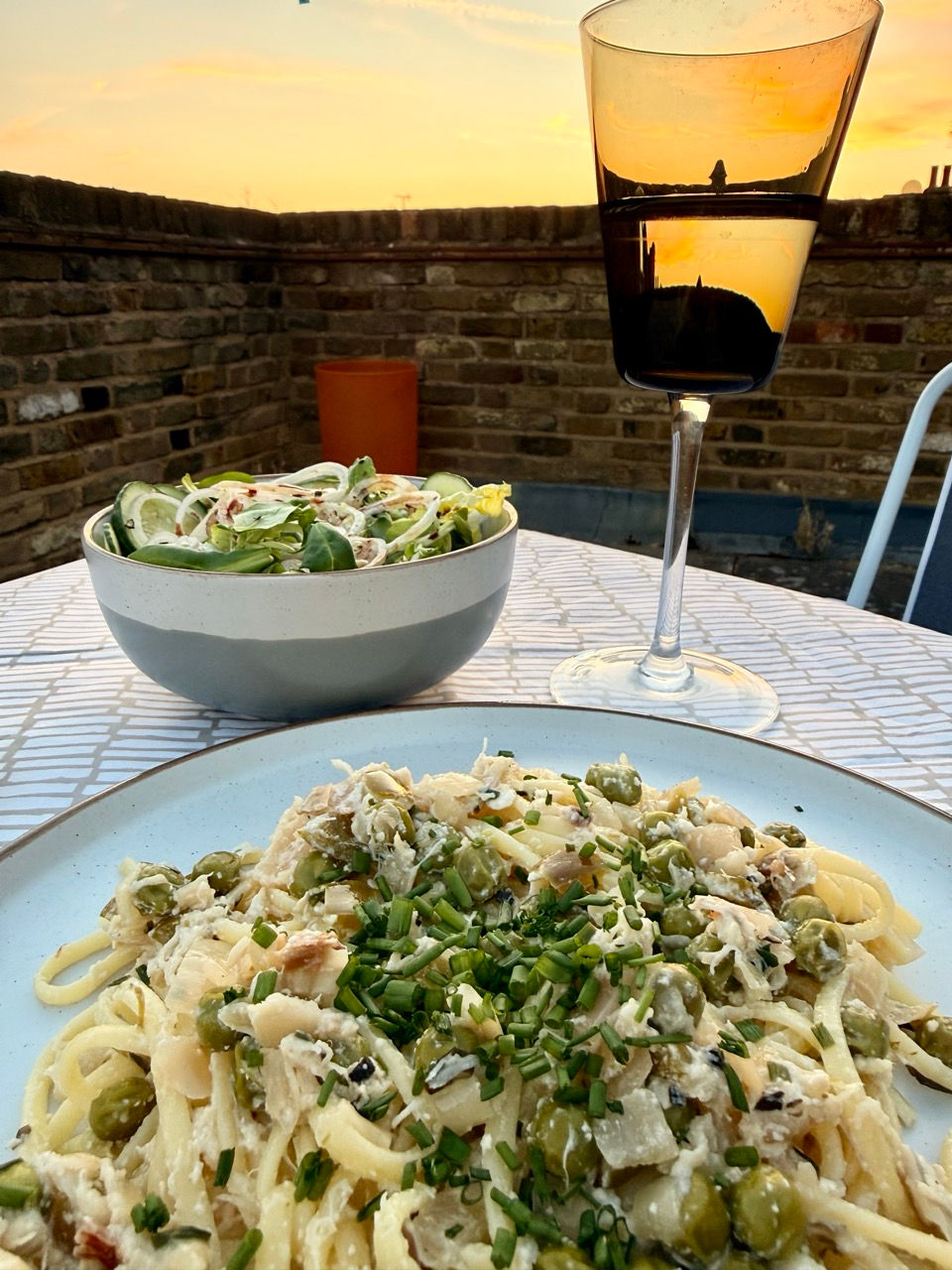
Skinny pasta, skinny onions
If you ever make this dish with onions as opposed to shallots—as I have done before—you will immediately understand why it needs to be shallots. In a sauce of relatively few ingredients, they really are the base that brings it together. And, given that most of those flavours are fairly delicate—white crab meat, fresh green herbs, peas—it is the similar subtleness of shallots that makes it work so well.
It's also why it is important to cook them on a lower heat than ordinarily used to soften onions in many Italian sauces. They cook quicker than onions and you want them to gently soften rather than almost immediately progress to caramelisation.
On the pasta front, I am specifically stating linguine, returning vehemently to the pasta with which I initially experienced it. Yes, you can use other pastas and it will still taste good, but in experimenting with it, I found spaghetti too thin, and tagliatelle too thick to optimally do what you want to do with this particular sauce.
If you want to get really specific about it, I always use a No.7 linguine, the quintessentially Ligurian pasta. It's somehow not only a pleasant reminder of Liguria (one of the regions of Italy I love the most) but also of the collections in the museums in Nervi where the art and design mirrors Italy's transition to a modern industrial nation from the late 19th century onwards. It was during this period that machines were invented that could guarantee the specific shape and thickness of pastas—linguine No7, spaghetti No.12, fettuccine No.6, and so on. At a time when pasta was sold in opaque cardboard boxes rather than plastic or boxes with little plastic windows, this rational numbering system was a way of helping the put-upon Italian Mama know exactly what pasta she was buying.
The heat is off
One of the things I can't stress enough is that the vast majority of the cooking of this dish needs to happen on low-medium and low heat. In fact, the only time you increase things to a medium heat are in the final finishing stages, and even then, only briefly.
This is for a number of reasons. One of them, relating to the shallots, is explained above. The other two are the ricotta and the white crab meat. Ricotta has a very particular way of melting, but if you actually "cook" it, it will coagulate and become lumpy. And white crab meat—which is already cooked—loses its charm if overcooked.
If in doubt, it's better to keep the temperature very low and allow things a little more time to cook or fully heat through.
Take note:
This version is for 3 to 4 diners, depending on appetite and any side dishes. But, you can easily scale it up for a larger group—as long are you have a pan big enough in which to finish the al dente pasta.
I often make this dish in larger quantities than needed. Although you can only store it in the fridge for a couple of days because of the crab, it never goes to waste. It's perfect in a heatwave when you want to minimise time spent in the kitchen. Simply sprinkle with a little water and reheat in the microwave on medium power (e.g. 650w) so you don't nuke the crab meat, and you have supper all over again.
It is also great cold as a kind of pasta salad. Dress with some extra virgin olive oil, sprinkle with (uncrushed) flaked almonds and chopped chives and voila!

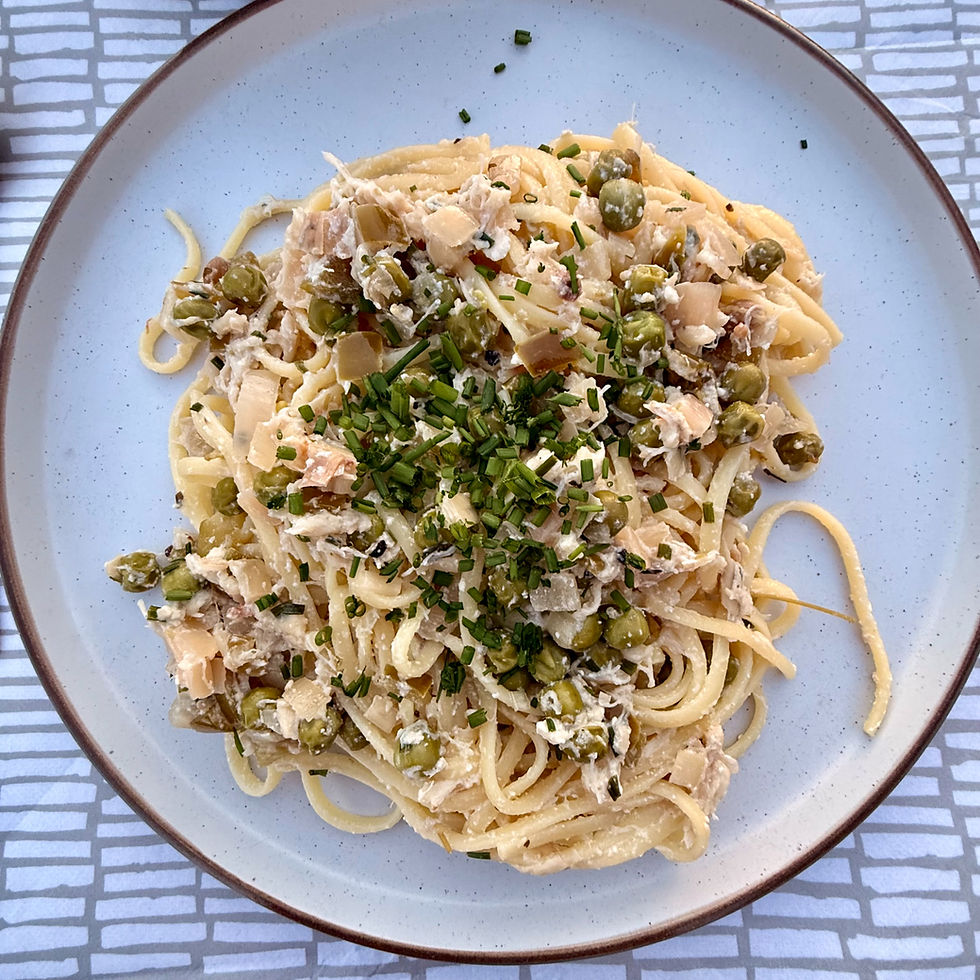
The images show me cooking it in slightly different quantities from those in the recipe.
3 top tips to get this recipe right: |
|
|
|
Shopping list
for the linguine with crab, peas and lemon
Approx. 80-90g (dried) linguine per diner
Approx. 150g cooked white crab meat; fresh, frozen and defrosted, or tinned
4 or 5 large echalion shallots; diced
1 green bell pepper; diced
Approx. 1 cup garden peas; steamed or parboiled
A clutch of fresh young thyme; chopped
A clutch of fresh chives; chopped
4 or 5 cloves of garlic; chopped
5 to 6 tbspns virgin olive oil (or extra virgin olive oil)
Approx. 200ml dry white wine
The juice and zest of 1 fresh lemon
200g ricotta cheese
1 handful of flaked almonds; crushed using a pestle and mortar (optional)
salt and pepper to taste

Side dishes
I'm serving it here with a very simple salad of little gem lettuce (lattughina), lamb's lettuce (valeriana); cucumber and raw shallots dressed with balsamico, extra virgin olive oil and black pepper, partly because I am a big fan of tasting the same ingredients raw and cooked in the same meal.
Of course you can serve it with basically any form of side salad you prefer, if any at all. The only salad ingredient I think does not work well is rocket (rucola). I tried it once, thinking it would be an nice contrast to the delicate flavours in the pasta dish, but in practice it just seemed to overwhelm them.
Cooking Method
the linguine with crab, peas and lemon
When you are almost ready to start cooking, remove the white crab meat and ricotta from the fridge so that they have time to return to an ambient temperature. For this dish you don't want them going into the pan chilled
In a large frying pan or pan with curved sides—I use a wok—with a lid, heat the olive oil on a low-medium heat. When hot, add the shallots and sauté, stirring
As soon a the shallots soften, add the green bell pepper and stir in so that it is fully coated in the oil. Sauté for about a minute or so, then add the garlic, and cook for another minute or so, stirring. Add half of the wine, cover and allow the ingredients to gently simmer until the wine is almost fully cooked off
Uncover, add the thyme and lemon zest and stir in. Cook for a minute, then add half of the lemon juice, stirring in. Season with salt and pepper while the lemon juice cooks in. Then add the remainder of the wine and a large piece of the squeezed lemon. Re-cover and allow the liquid to cook down
When the liquid has cooked down almost entirely, reduce to a low heat. Remove the piece of lemon and add the ricotta. Gently stir the ricotta in so that it melts and assimilates as much as it will. Don't rush it. Ricotta won't become a nice smooth liquid. More importantly, make sure that the heat is not too high or else it will coagulate into "lumps", a bit like panna cotta—which is why it is often used in things like pestos where it is merely melted by the heat of the pasta
Once the ricotta is assimilated, add the peas and fold in. Cover and allow them to heat through for a few minutes, checking regularly that the ricotta is not being "cooked". NB: if the ricotta starts to bubble, briefly remove from the heat until you have reduced the temperature
Add the crab meat and gently fold in, trying not to break up some of the larger flakes. Don't worry about the crab being evenly distributed. White crab meat has a strong flavour and after two or three minutes—as long as it takes to fully heat through on a low heat—the sauce will take on that flavour in a pleasantly subtle way
Once you can taste the crab flavour in the sauce, add the chives and gently fold in. Ideally time this for your linguine to be ready exactly at the point the sauce is ready. If not, cover and keep warm on a bare minimum heat until the linguine is cooked
Before you drain your pasta, add 60 to 80ml of the pasta water to the sauce (depending on how thick the sauce is). Increase to a medium heat, stirring in the pasta water. Add all of the drained linguine to the sauce. If using the almonds, sprinkle the flakes over the top of the pasta, then fold in the linguine—I find tongs really useful for this—so the pasta is evenly coated with the sauce
Remove from the heat. Pour over the remaining lemon juice and briefly fold it in. It doesn't have to be evenly mixed throughout. Cover and rest for a minute
Plate, garnish with fresh chives, and take to table with any side dishes
Alternatives
This is a pescatarian dish. I never use anything other than white crab meat for this dish if I can help it. But, if you have no access to white crab meat, the best alternatives are (raw) scallops or (cooked and shelled) crayfish tails. If using either of these, reduce the ricotta by a quarter.
The lactovegetarian version—simply don't add the crab meat and double the quantity of crushed flaked almonds—is delicious, a dish in its own right with a somewhat different character. But I have never tried a vegan version mainly because I have no idea what plant-based alternative might work in lieu of ricotta, as much for how it behaves as it tastes. You may well have this knowledge.
I have begrudgingly cooked versions for obsessive carnivores, with pre-cooked cubes of pancetta. The low heat and level of fat in pancetta is a disaster waiting to happen if you add them without first cooking them. They thought it tasted great. I thought is tasted okay, secretly sneering at them not embracing the beauty of crab.
Pairings
While I am sure it is possible to find light reds or rosé wines that could work with this dish, it's never occurred to me to have it with anything other than white wines, possibly because I always cook it in very hot weather.
The first time I had it was with a La Baracca Macerato Cinque Terre Bianco, which was superb. And, together with Bisson Marea Cinque Terre, I think these are my two top recommendations for this dish. But, be warned, you may well have to go to Liguria and bring them back in your luggage as I did because the locals are very fond of their local plonks and most of these smaller-batch wines never make it out of the terroir.
Two other random recommendations I have found great with this dish are Faustino Rivero Ulecia Albariño, which is oddly light for a Spanish Albariño, probably why it works so well with this crab dish in hot weather, and Movia Rebula - Ribolla Black Label. Though slightly more full-bodied, this Slovenian white is very dry but doesn't overpower some of the subtler flavours in the dish.
Unless a dish of spicy Asian provenance, beer and crab just don't work for me, sorry. Drink your beer before you sit down to eat.
All of this said, I often end up cooking this dish when it is simply too hot for booze. My favourite non-alcoholic tipple with this one is to infuse still mineral water with lemon and cucumber in the fridge for about twelve hours and then serve it in a pitcher with ice.


Comments