


Moroccan roast duck with figs
Updated: Mar 12
Moroccan duck roast duck with figs is a delicious dish from the Moroccan High Atlas, served here with smoky vegetables and couscous. Its benefits are that you're likely to get at least one additional meal out of this dish—maybe more—and possibly discovering a new Japanese-Moroccan sauce.

This isn’t something I learned on my travels. Rather, I learned it knocking about on my own doorstep, albeit it from one of London’s top Moroccan chefs.
It’s not a complex tale. Somehow we always seemed to be in the group on the little terrace in front of the restaurant and nightclub where he worked, taking a break from the heat and pumping music of the parties that inevitably happened during the various art fair and fashion season parties. Just as often, my friends and colleagues would eat his dishes for supper before the party kicked off.
On one such occasion we got chatting after I told him I was in awe of one of his “tapas” dishes: a dish of duck pressed paper-thin between two layers of brick pastry spread with date paste and topped with sesame seeds. I told him that I would never attempt something so delicate.
He smiled, thanked me and told me that, while it was a great dish, actually, he had more love for some of the home cooking with which he had grown up in a Berber region in the Atlas Mountains above Marrakech.
I asked him what kind of dishes he meant, and he reeled them off in great detail. I made him slow down when he got to this one, recording it on my phone as I insisted he talk me through the recipe. It was somewhat surreal, the mad high-pitched laughter of the glitterati and thumping dance music in the background. Nonetheless, he happily obliged and it has long since been a personal favourite.
A Berber duck
One of the things he told me was that duck was not a particularly common ingredient in Moroccan cooking compared with chicken or lamb and was mostly reserved for special occasions—such as when he returned home to visit his extended family—which is partly why he associated it with happy occasions. However, in more recent years, along with realising an increased demand for their organic produce in general, farmers in the High Atlas had cottoned on to the higher returns on duck rather than chicken in supplying local luxury tourist markets and it was more widely available than when he was a kid.
There were also a couple of other fascinating things I learned. Seemingly, in the region he came from, it was rare for anyone to cook a whole duck. Rather three or four ducks could provide multiple and varied meals for large families and friends.
For example, one such dish was roast duck legs, such as in this dish, often roasted together with the wings, especially if children were also attending the meal. These were not cooked in a tagine, but roasted in open metal pans or terracotta dishes.
The highly prized breasts would be filleted for use in other delicacies, such as his delicious pressed duck with dates recipes, or sold to local tourist market kitchens, especially the large Muscovy (Barbary) duck breasts.
The remainder of the bird would be slow- cooked in tagine dishes, the meat flaked into any number of dishes with tomato-and-vegetable sauces as it came away from the bones during the slow cooking. And, finally, the bones and anything remaining would be used to make stocks and broths.
Thus, this dish is roasted rather than cooked in a tagine. Similarly, though very similar to numerous tagine-cooked dishes, the smoky vegetables for this dish are traditionally cooked in a cast iron pot with a lid on the range, over open fire or in an oven. The reason for this probably becomes clear when you roast the duck legs. Essentially, they take barely an hour to cook. Cooking the vegetables in a pot certainly takes longer, but not as long as the traditional slow-cooking of a tagine. Thus, it is still easier to coordinate everything is ready at the same time because this isn’t a “one-pot dish” in the way many tagine dishes are.
A saucy tale
My fusion sauce recipe that I've included is not part of the original—it’s usually served with the intrinsic sauce of the smoky vegetables alone. And, indeed, it would be more accurate to describe my little twist as “Moroccan-inspired Japanese fusion”.
The way I was taught the original was that you would save the juices and fat drained from the duck with its “passive” infusion of figs, pumpkin and ras el hanout to cook other dishes. But, knowing myself—and the number of times I've emptied unused duck fat and juices into the composter because they disappeared to the rear of the fridge and I promptly forgot them—I was keen to find a way to use them appropriate to this dish itself. The duck roasts to a reasonably crispy exterior finish, ideally suited to an interesting sauce.
My inspiration comes from a technique I was taught by a Japanese chef; sauces that are almost classic French in consistency that use no flour or grain thickening agent. Instead, it is about the combination of fats from the meat, natural fruit sugars, soy and sesame being combined in the correct order that creates a thick, lush sauce. So, I thought, I would experiment to create a Moroccan riff on the Japanese version—using freshly squeezed orange juice, tahini and the sauce from the smoky harissa vegetables instead of the yuzu, sesame paste and ramen broth of the Japanese version. But, of course retaining the dark soy that is the magic that triggers the thickening.
The caveat is that the quantities in the recipe below are based on the fat and juices that come off just two ducks’ legs during roasting. And, that produces a sauce way in excess of what is needed. So, heaven knows how much sauce you’d end up with if you scaled everything up to work with the fat that comes off a whole duck (or more duck legs).
A whole lot of vegetables
As will be fairly obvious from the images—where I cooked a meal for two—the quantities of the vegetables in the recipe below will be enough for 6 or more diners as part of this larger meal. But, I always cook them in these minimum quantities. There are two reasons for this. Somehow, cooking them in reduced quantities never seems to get the flavours and consistency right and, what do you even do with half a tin of chopped tomatoes once it's open, anyway? The second reason is that you can use the (substantial) leftovers as the basis of a second (vegan) dish that that makes for convenient meals. Since this "second life" dish involves very little effort, I often cook this main dish of a weekend, smugly knowing that I have built the foundations for an easy midweek supper when I really don't have the time or energy to start something from scratch.
It's also one of the reasons I recommend whole, skin-on, scrubbed small carrots that are not topped-'n-tailed. Small heritage varieties like Chantenay are magnificent in their ability to not become mushy, overcooked or disintegrate as long as you cook them whole with the skin on. This is particularly useful for "leftovers" dishes where they will be recooked.
Depending on your situation, both the Moroccan smoky vegetables and the secondary dishes freeze really well meaning that you can stretch it to more than one dinner or lunch.
The quantities in this meal are a bit like Lego: you choose the number of duck legs based on the number of diners, prepare the quantity of couscous or flatbreads and then don't even have to think about the quantity of smoky vegetables until you go above 6 diners.
3 top tips to get this recipe right: |
|
|
|
Shopping list
for the Moroccan roasted duck with figs
1 or 2 duck legs per diner, depending on size
Approx. 3tspns ras el hanout
⅓ of a small pumpkin, cut into wedges; skin-on and de-seeded (or butternut squash)
4 to 6 fresh figs; about 2 per diner
Approx. 2tspns sunflower oil
Approx. 2tspns garlic & ginger paste
2tbspns flaked almonds
Salt and pepper to taste
for the Moroccan smoky vegetables
Approx. 400g small variety fresh carrots (e.g. Chantenay); skin-on; scrubbed
1 large red sweet pepper; deseeded and sliced
4 cloves of garlic, very finely diced
1 tin 400g chopped tomatoes in their juice
1 small fresh lemon; cut into quarters
A generous clutch of fresh flat leaf parsley, chopped
Olive oil; about 3 to 4tbspns; enough to coat the base of your cooking pot
3 or 4 echalion shallots, cut into thick slices (or 8, blanched, peeled round shallots)
3tspns of smoky harisa paste; store-bought or make it with this recipe here
A pinch of salt and freshly ground black pepper to taste
A dash of boiling water
Side dishes
Couscous — I'm doing minted couscous with garlic and herbs, but any couscous works
Flatbreads — briefly warmed in the oven
I usually opt for couscous with the duck legs, but often like flat breads when having the "leftovers hotpot" (see below)
for the Moroccan fusion sauce (optional)
All of the duck fat and juices drained from the roasting pan
Approx. 4tbspns of the tomato sauce taken from the cooked smoky vegetables
The juice and pith of a medium-large, fresh orange
1tbsn tahini
2tspns pomegranate molasses
1tbspn dark soy
Cooking Method
the Moroccan smoky vegetables
Start with these because they take the longest to cook. You can also make this 24 hours before cooking the duck and reheat before serving.
While heating the oven to 180°C, brush the bottom of a deep casserole dish with a little olive oil so it is barely coated. It is primarily to prevent the vegetables at the bottom of the dish from sticking. Place the carrots in the dish, push the thick slices of (or whole) shallots in among the carrots and layer the sweet red pepper on top. Squeeze the juice from the lemon quarters over these ingredients and allow to sink in. Then push the squeezed lemon skins in around the edge of the dish
Add the tinned tomatoes and their juice. Add the harissa paste to the empty tomato can and dilute with a small amount (e.g. 20 to 30ml) of boiling water and slosh about. Pour this over the tomatoes. Using a fork or chopstick, work the tomatoes and the spice liquid right down into the dish. Finally, sprinkle the chopped parsley over the top. Don't season at this point. Cover and place in the oven. NB: don't wait until the oven is pre-heated. Cook for 40mins
Remove from the oven and gently move the ingredients about (trying not to break up the shallots), pushing any parsley still at the surface down into the hot evolving sauce. Re-cover and return to the oven. Cook, undisturbed for another 40mins. By now the carrots should largely be cooked (if not, cook, covered, for a little longer)
Increase the oven temperature to 200°C. Taste and season with salt and pepper as needed. Return the dish to the oven, uncovered. This reduces the sauce. Cook for approx. 20 mins, checking that it has not cooked down too much halfway through. You want it to have a consistency that is slightly more liquid than a classic Italian pasta tomato sauce. If ready, cover and put to one side (if not, cook for a little longer)
When cooking the meal, place, covered in the oven with the duck for the last 15 mins of the roasting. Then plate or take the relevant quantity to table in a serving dish
Once cooled, store the remainder covered in the fridge for use in the "leftovers" dish
the Moroccan roasted duck with figs
One to three hours before you roast the duck legs, place on a plate and season with a little rock salt and a generous sprinkling of ras el hanout. Gently rub into both sides of the duck legs with clean fingers. This isn't a wet marinade, but you want at least one hour for the seasoning to infuse its flavours. Place in the fridge, skin side up, uncovered. This will slightly dry the skin which assists it becoming crispy
Cover the bottom of a roasting pan or ceramic roasting dish with a thin film of sunflower oil. Place in the oven while you preheat to 180°C. Once the oven is preheated, remove the roasting dish and carefully place your duck legs at the centre of the pan, skin side down. Arrange the pumpkin wedges around the edges of the pan, rub on garlic & ginger paste with clean fingers. Cut a long vertical slit into each fig. Arrange them so that they are in direct contact with the duck. Place a few thin lemon slices over the duck. These are mainly to prevent the meat from drying out rather than infusing a notable flavour. Place in the oven and roast for 30min
Remove from the oven and discard the lemon slices. Gently pour off the fats and juices (into the saucepan you will use to make the sauce if you are making it). Turn over the duck legs and pumpkin wedges. Return to the oven and roast for another 10 to 15mins; until the skin side is cooked
Remove from the oven and pour off any additional fats into your saucepan. Turn the heat in the oven up to 200°C and sprinkle a handful of flaked almonds over the duck legs and pumpkin. Return to the oven and roast for a further 10 to 15mins, until the skin becomes lightly crisped and the almonds almost toasted. During this time prepare your couscous and sauce
Once optimally cooked, allow to rest for a few minutes. Then plate the duck legs and pumpkin. Gently slice each fig in half before adding to the plating. Plate the smoky vegetables and couscous, or take these to table in serving dishes
the Moroccan fusion sauce (optional)
Add approx. 4tbspns of the sauce from the smoky vegetables to the saucepan with the drained-off duck fats and juices. NB: this should be an actual saucepan; a very small pan meant specifically for making sauces, ideally copper, but who's quibbling...
Squeeze the fresh orange juice into the saucepan, heating on a medium heat, stirring. As it comes to a vigorous simmer, add the tahini and stir in vigorously. At first it will clot: don't worry, simply stir continuously. As the tahini heats, it will melt in
Once the tahini is assimilated, add the pomegranate molasses, still stirring. Soon, the sauce will begin to thicken
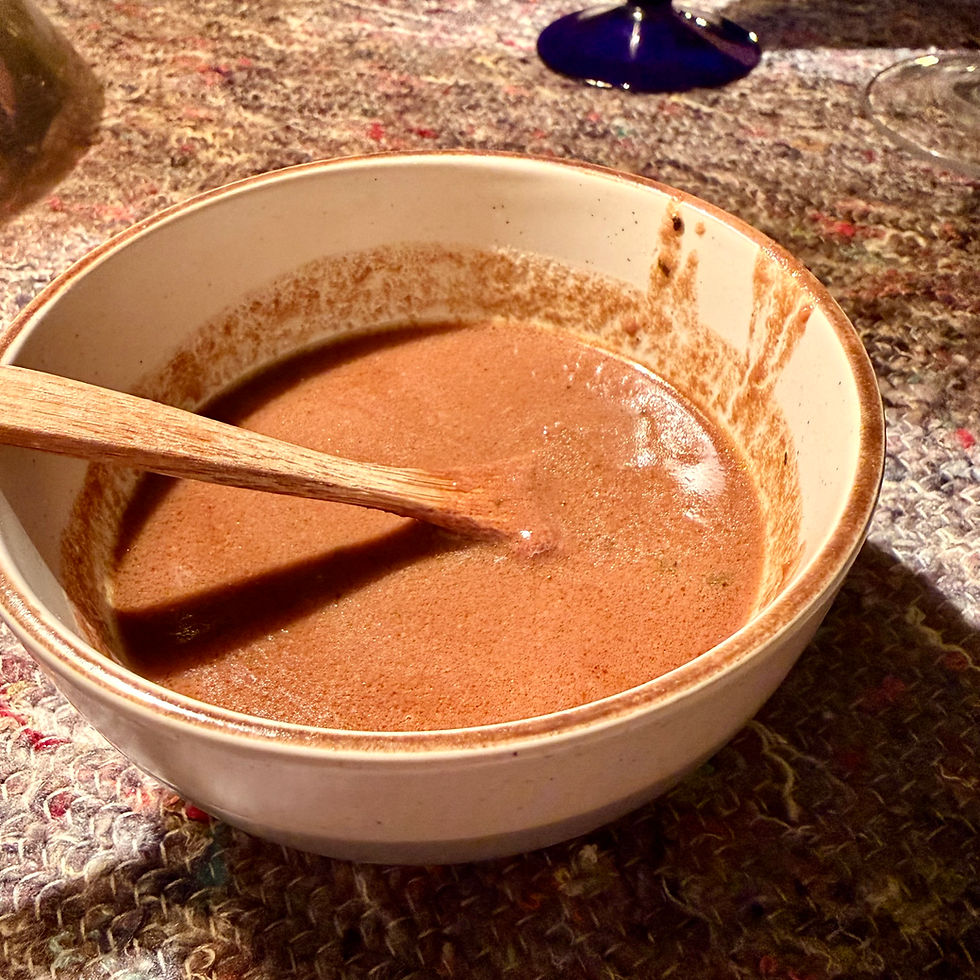
Add the soy sauce stirring as you do. Be prepared: very soon it will thicken exponentially and change colour to a deep chocolate brown, very similar in colour to a Mexican mole sauce. As soon as it achieves this thick, silky consistency, remove from the heat. Decant to a sauce dish and take to table. NB: I advise diners be allowed to add their own sauce at table rather than dressing the duck for them. This is an unusual and rich sauce with a combination of a citrus undertow with a notably umami pungency. Thus it tends to get a love-it-or-hate-it response
The aftermath
My sauce in this recipe is not part of the original—it’s usually served with the sauce of the smoky vegetables alone. And, indeed, it would be more accurate to describe the sauce as a “Moroccan-Japanese fusion”.
But, long before I ever had the whacky idea of doing this sauce, I already understood how the smoky vegetables can morph into additional meals. The most obvious of these is to simply added cooked chickpeas e.g. canned or bottled chickpeas. If you're really pressed for time, simply mix them in and then microwave and serve with couscous or flatbreads.
Better still, stir in the chickpeas and cook in slowly in the oven at 170°C. Overall, this is better because it allows the "latecomer" chickpeas to retain texture while still being able to absorb a little intrinsic flavour from the the dish.
The second option—and often there is enough left over for both—is to make a Moroccan-inspired soup by adding a vegetable of chicken stock to the leftovers in a large part and working down into a liquid with a hand-held blender. One of my personal favourites is to make this soup with chicken stock and then add flaked, steamed chicken.

Alternatives
This isn't a dish easily adapted for vegans and vegetarians since duck lies at the heart of it. As a dish with three elements, the smoky vegetables and couscous are vegan by default. So, the main challenge is the other. I recommend roasting the pumpkin and figs either with aubergine, whole fennel or very large (e.g. Portobello) mushrooms seasoned with ras el hanout. Obviously each of these have different roasting times, so you just need to add them to the pan at the appropriate time.
For pescatarians, there are basically two routes to take, even though the High Atlas isn't exactly known for seafood. The first is to treat whole squid tubes as if they were the duck in this recipe—and having cooked this on numerous occasions, I can testify it works—placing whole seasoned squid tubes into the roasting pan in only the last 20mins.
The other alternative is to slap in a whole lobster. I have only done this a couple of times. So far. the seasoning hasn't really got beyond the shell (which is delightful to suck upon). Fragrant and delicious, certainly, but not so much flavour-infused by the spices. Still. ones suspects it will impress the bougie neighbours...
This is already a meat/animal protein dish. Nonetheless, if you really want to make your leftovers dish a carnivore orgy, add a few seasoned lamb meatballs or sausages to the roasting pan about 25 to 30mins before you wish to serve.
Pairings
People don't really bother to ask. They simply assume I would have this dish with one of those sun-drenched Sicilian Catarattos or something from Southern Europe. I am sure they would work. Yet, I respect the man who taught me this recipe and his respect for his mother and grandmother who would not approve of alcohol. Thus I always pair it with sparkling water infused with fresh orange and basil or really high-end Australian non-alcoholic Rieslings that actually taste like wine. Go figure.


Comments