


Stir fried monkfish with Sichuan pepper
This pescatarian stir fried monkfish with Sichuan pepper is not a traditional Chinese recipe, but something I created after being reminded of the joys of monkfish in Scotland. Here the buttery monkfish works perfectly with spiky ginger, elegant star anise and tingly Sichuan pepper. Accompanied by egg fried rice and a side dish of bok choy and sweetcorn, it is can be cooked in no time at all.

Sorry, Da'...
This isn't one of the treasured recipes that my father scribbled down in Asia in the 1960s. But it certainly owes everything to what he taught me about Chinese cooking as a kid.
Many years ago, while in Scotland, I chanced upon some fantastic monkfish in the local fishmonger in a small town on the Angus North Sea coast. It was already lunchtime on a Saturday and the wyfie behind the counter was all smiles, but kept looking at her watch and calling out in a stage whisper to her colleague cleaning up the shop, "Agnes, what time do we tee off?"
I took the hint. I feared she might be transformed into a vexatious bissum should I keep her from her golf. Unbeknownst to her, my brain was ticking over wondering what might be in my friend's pantry. None of us fancied driving for 25 minutes to get to the nearest sizeable supermarket. And, besides, it could nae be fried rice, because I had nae planned in advance...
The make-do-and mend version I served up—with noodles—was very good. So dinnae waiver should you unexpectedly find yourself gripped by a desire to cook monkfish in a Scottish country house without having ordered in some of the spices and veggies and pre-cooked your rice...
But, much as I and everyone else loved that meal, I found my mind wandering (wondering?) as guests at dinner talked of their recent fun times in Barcelona and how Amsterdam was still a terrible place to find a decent restaurant if you don't know where to go... I thought I could finesse it a little better with better chosen ingredients. And, that's what I did as soon as I got back to London. If anything, it was about stripping it back to "less is more". For example, the lacklustre Chinese 5 Spice in the spice rack of a Scottish country kitchen gave way to freshly ground Sichuan pepper etc.
Apocryphal fish
My beloved Julia Child is credited as having coined the term for monkfish as "poor man's lobster' during the economic woes of the 1970s. But, while her huge American television audience may have heeded her advice in an age before globalised television, she can't be blamed for its trendification—and subsequent price hikes—in the UK. In the 80s and 90s, you could still buy this butt-ugly-but-delicious fish at very reasonable prices. Expect that no longer. It is now expensive. I'm not sure who is responsible for this, but I don't remember UK TV chefs particularly giving it profile, nor has it ever been a regular feature in UK supermarkets. I suspect it was probably a new generation of chefs who arose in the noughties that had an openness to viewing the UK's wealth of immigrant cuisines as deserving their place at the Michelin-starred table. For example, monkfish is a highly regarded delicacy in many Caribbean and South American cuisines.
Appropriation, very possibly, but before you shout that too quickly, remember that this was also the first generation of "fusion" chefs in which Black British chefs were acknowledged as top tier, bringing the influences of their cultural backgrounds with them. Food politics aside, expect to pay about the same prices for it—by weight—as prime beef or lamb. On the upside, it's far healthier while being just as filling.
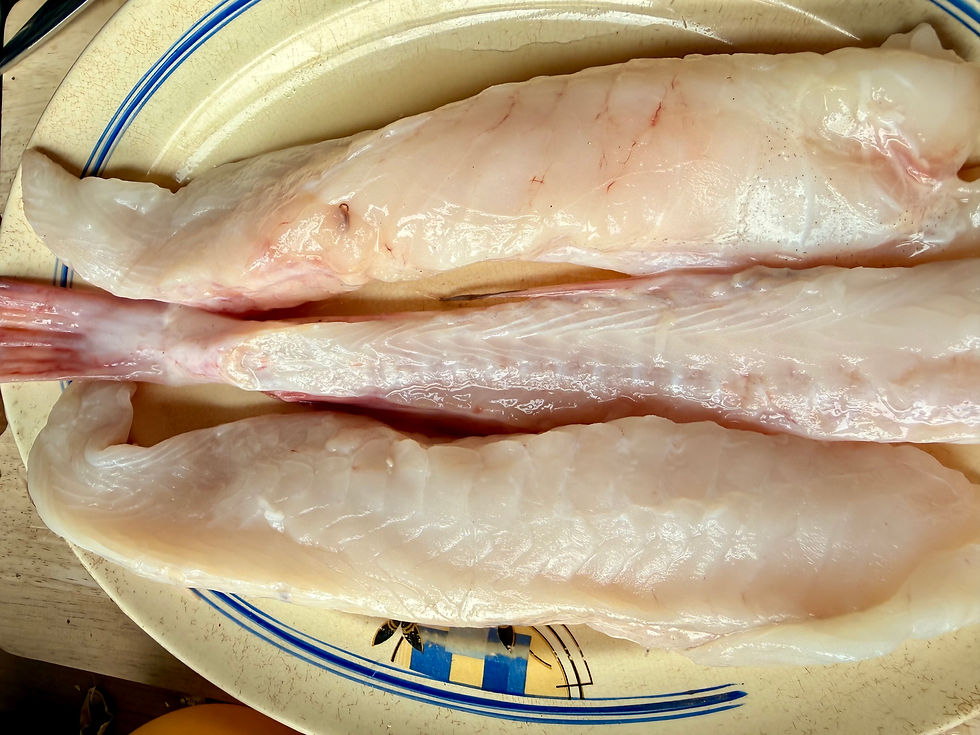
If you don't know how to fillet it yourself—it has a monstrously strong spine—ask your fishmonger to do it for you. In general, one whole monkfish will easily feed three to four people with this dish, though it will depend on the size of the fish that varies quite a lot by species.
Simply not simple
I generally hate it when TV chefs brandish about the word "simple". I take it as forewarning that their proffered dish is going to be dull. But, unapologetically, this is a very simple dish and it is fantastic. The most important thing is that you have good quality monkfish. And, no, it doesn't have to be fresh. This is one of those fish that freezes exceptionally well and, if you live in a part of the world where it's impossible to get fresh monkfish—the most delicious varieties are native to cold water, though species in the Mediterranean are also valued—frozen fillets fully defrosted slowly overnight in the fridge work perfectly well.
The second important thing is that you have good quality Sichuan (Szechuan) pepper, not the pre-milled stuff, but the whole seeds that you'll grind freshly yourself using a spice grinder or a pestle and mortar. I'm not going to get into the whole discussion about exactly what this spice is and how it behaves—try Google if you're interested—but if you like Kung Pao, then you'll probably like this dish, though it may be a bit more 'tingly' than the takeaway versions that often use pre-milled Sichuan pepper. Whole Sichuan pepper is available in many specialist Asian supermarkets or online in many parts of the world. While it is one of the traditional ingredients of Chinese 5 Spice mix, I think that it is the best example of the difference it makes between using a pre-milled spice versus doing it just before you cook the dish. Basically, it's all in "the tingle". While the whole seeds keep well for a very long time, its unique molecular magic tends to wear off if you grind it and keep as a powdered spice for months and months on end.
That said, if you are trapped in a Scottish country house—or somewhere with a comparable lack of access to Sichuan pepper—one or two tspns of Chinese 5 Spice mix is a viable back-up plan (but then leave out the fresh star anise, another of the 5 in the iconic spice mix).
Woks at stake
One of the biggest challenges for wok cooking is that the contemporary ceramic or induction hobs many of us own simply don't reach a temperature suited to wok cooking. For example, there are certain dishes that I only cook in clement weather when I can decamp to the outdoors with my trusty Boy Scout camping gas cooker. Obviously, if you have an older gas hob, you can fire it up to the necessary heat, an advantage.
High heat is important with this dish. If monkfish isn't cooked at a sufficiently high temperature—which helps seal it—it has a tendency to exude water. Naturally, you want a certain amount of liquid in the pan with which to create the sauce. But, you're not poaching it. So, if you have a less-than-fierce hob and the level of liquid in the wok rises above a quarter of the depth of the ingredients during the cooking, pour the majority of it off (keeping it to one side in case you need it later to produce the adequate quantity of sauce).
Take note:
As always with wok cooking, do all of your prep in advance because the cooking process itself is very quick and you won't have time to chop veggies once the wok is in action. Once the preparation is done, the cooking process will take 30mins or less in total.
I'm using dark soy sauce here because I think the flavour is better with this dish. But, if in keeping with traditional Chinese cultural aesthetics, this darkness offends ye, use light soy sauce instead. Similarly, use white sugar instead of brown if you want a lighter colour.
Once cooked this fish dish will last well in the fridge for up to 3 days, but it does not freeze well once cooked. Conversely, egg fried rice freezes very well and is easily reheated in a microwave as long as you ensure the rice it fully reheated.
Egg fried rice is a bit of a catch-all in that egg is added to Chinese fried rice dishes in different ways—such as adding the raw eggs into the rice towards the end of the cooking—but I am doing my favourite version here.
This version is for 2 to 3diners, depending on appetite and any side dishes.
The images show me cooking it in slightly different quantities—such as smaller quantities of the side dishes.
3 top tips to get this recipe right: |
|
|
|
Shopping list
for the stir fried monkfish with Sichuan pepper
1 (partial) fillet of monkfish per diner; fresh or frozen and defrosted; each fillet cut horizontally into fairly large bite-sized pieces
2 large echalion shallots; peeled, cut into quarters vertically and pulled apart
1 large red bell pepper ; cut into thin slices
3 thumb's lengths of fresh ginger; peeled and cut into "matchsticks"
3 or 4 cloves of garlic; peeled and thinly sliced
1 whole star anise
2 tspns of freshly ground Sichuan pepper
Approx. 3tbspns Shaoxing cooking wine (use sherry as an alternative)
2 tspns brown sugar
1 tspn cornflour; dissolved in a tablespoon of boiling water
2 tbspns sunflower oil (or vegetable oil)
1 tspn sesame oil
Approx. 3 tspns dark soy sauce
for the egg fried rice
Approx. 450g white long grain rice; boiled, cooled and chilled in the fridge for 24 to 48 hours
2 eggs; beaten
1 cup garden peas; fresh or frozen and fully defrosted
2 tbspns sunflower oil (or vegetable oil)
1 tspn sesame oil
Approx. 2 tspns dark soy sauce
for the bok choy and sweetcorn
Roughly 1 small bok choy per diner; chopped into large pieces
Approx. 250g fresh baby sweetcorn; cut into large pieces
2 tbspns sunflower oil (or vegetable oil)
1 tspn sesame oil
1 tspn light soy sauce
1 tbsn oyster sauce
Cooking Method
the stir fried monkfish with Sichuan pepper
Heat the oils in a wok on a hight heat. Add the shallots and stir fry for about a minute, then add the bell pepper. Stir fry together until the shallots begin to soften (the pepper may still be fairly crisp) adding the star anise and a dash of soy sauce
When the aroma of the star anise releases, add the ginger and the garlic, stirring constantly until their aromas release
Add the monkfish pieces and stir fry, mixing with the other ingredients and adding the remainder of the soy sauce
When the monkfish is approximately half-cooked, add the Sichuan pepper. Stir almost constantly so that it is evenly spread throughout the wok. When the monkfish is cooked, remove using a sieve spoon and place to one side
Add the Shaoxing cooking wine to the wok, followed almost immediately by the brown sugar and stir in to the other ingredients and cook for about a minute, until the brown sugar has fully dissolved. Then add the cornflour slurry, stirring constantly. Very soon the sauce will start to thicken. When it is almost at the ideal consistency, add the monkfish back into the wok and fold into the sauce
Once the fish is piping hot and the sauce at the ideal consistency, pour from the wok into a serving dish. Cover to keep warm while you complete the two side dishes. Then take to table for diners to help themselves
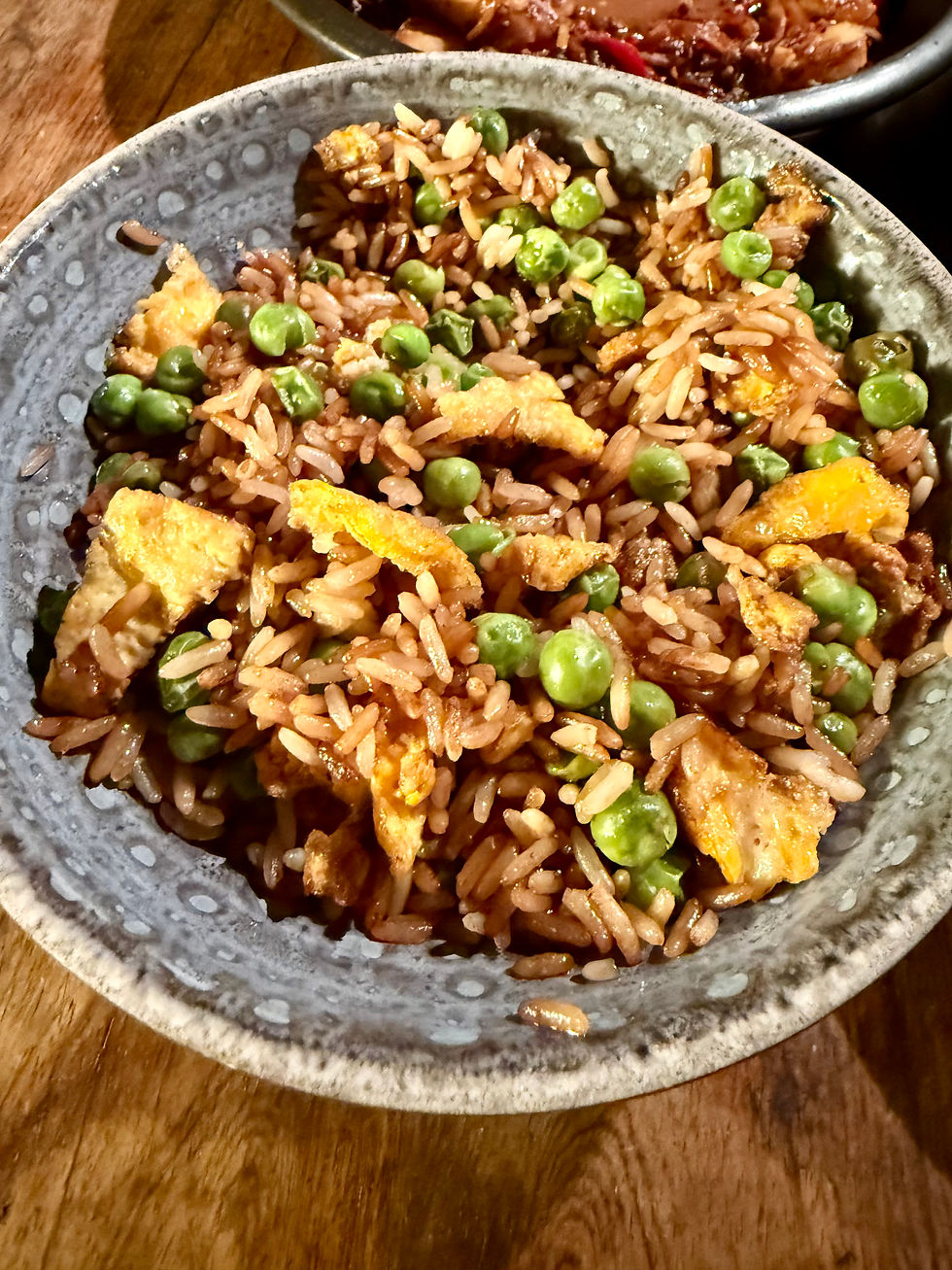
the egg fried rice
Heat half of the oils in a wok on a high heat. When hot, add the beaten eggs. You are essentially making a small omelette, but you are not going to turn it. Once almost fully cooked, slip onto a plate and break into thick strips using a spatula or knife. NB: you can also do this in a separate small frying pan. I prefer this because it saves time doing it simultaneous to cooking the rice, making it easier to take all the dishes to table while they are still warm
Add the remaining oils to the hot wok. When hot, add all of the cold rice, stirring almost constantly so that it heats through evenly and all of the rice is coated. When the rice is hot and shows first signs of sticking, add all of the soy sauce and stir in. After about 30sec, add all of the peas
Stir fry until the pease are cooked and the rice piping hot. You may also note that none of the grains stick together if you have wokked it to a suitable heat. If it sticks at any point, add tiny additional dashes of soy
Add the egg omelette back into the wok and break up into large pieces with a spatula as you fold it evenly through the rice. When all elements are cooked and piping hot, remove from the heat and keep warm, covered, before taking to table
the bok choy and sweetcorn
Heat the oils in a wok on a high heat. When hot, add the baby sweetcorn and stir fry for a couple of minutes—for this dish, the sweetcorn will remain fairly crunchy, the bok choy barely wilted—then add the bok choy, simultaneously adding the soy sauce
You will need to wok these ingredients together for barely a minute before the bok choy leaves are fully wilted and the stems begin to soften. As soon as this happens, add the oyster sauce and stir in. As soon as the oyster sauce is obviously piping hot, slightly caramelising on the sweetcorn, remove from the heat and place in a serving bowl
Take to table so that diners can help themselves together with the other dishes
Alternatives
This is a pescatarian dish. It's easily turned vegan or vegetarian simply by substituting cubes of tofu for the monkfish, something I often do because tofu is a lot easier to find as a last-minute option than good monkfish. The only potentially non-vegan element here is the oyster sauce in one of the side dishes. But, even while not openly stating it, most of today's readily available "oyster" sauces are vegan—because it's a lot cheaper to produce than the real deal that does actually contain oyster extracts. Either simply check the ingredients or buy vegan oyster sauce produced by numerous credible Asian brands that specifically offfer it.
For diehard carnivores, there is no reason you can't make this dish with thin strips of beef or bite-size pieces of chicken. But, remember that the combinations in this one is drawn straight from the nature of monkfish. So I would suggest that you also look at dishes that draw directly on the nature of these other ingredients. For example, in the case of the latter, you might be better off looking to my recipe for Kung Pao chicken.
Pairings
If fish seems like a natural reason to run in the direction of white wines, then I would say—especially with the liberal use of dark soy sauce in this recipe—you don't have to be too hung up on it.
On this occasion I had it with a Mosaicos Macabeo Sauvignon Blanc 2024. This dry Spanish white from La Mancha worked very well with this dish. Some of the very things that European oenologists had said about it—high acidity, herby, citrus, coriander—as "negatives" were exactly why I suspected it might work with this dish, which it did. Incidentally it has now gone on my "curry wines" list and, frankly, I thought it very drinkable and refreshing and did not find it particularly acidic at at all.
Back in the day I thought that what worked really well were slightly over-chilled Austrian Gewürztraminers of the ilk that have that slight "raisin" thing going on, something I think works particularly well with Sichuan pepper. But, no, don't ask me which: it was eons ago.
Similarly, back in the day, I remember a red that stood out with this dish was a light-bodied Beaujolais Villages number. Again, no memory of exactly what it was.


Comments